Smiling monsters in fancy suits think they will steal ever-increasing amounts of coal from America's public and Indian lands in Wyoming and Montana, to cash in for global investors by sale in China and India. Stealing with the help and leadership of complicit public officials, including all engaged in trickery of a Trans-Pacific Partnership. Coal is deliberately let go at a very small fraction of actual value. All of us know it is theft.
I criticize a naive Sierra Club campaign called Beyond Coal, that seems to stand in opposition of the theft. The campaign message should be, that coal should not be burned anywhere in nineteenth century power plants at not more than 30% efficiency. That related message would be that we can not allow export for uncontrolled usage. The actual and ineffective message, is just that we in the USA want our power from any other process, including nuclear fission. Coal with no local market is cheapened then, which is what the investors in export want. Off message, the Sierra Club campaign complains of local consequences of passing trains, that do include massive murder of salmon. The certain great harm from dust of open-car trains has led to tiny compromise, in proposing that coal be barged in the Columbia River transit.
In fact, coal reserves of the United States are immensely valuable, and must be counted upon to largely power our nation for hundreds of years. Plans to this end exist and are very real. Here is an example:
Solid Oxide Fuel Cells for Coal-Based Power
Coal can be used for power generation at better than 80% efficiency, slowing its extraction, letting us rely on it for hundreds of years, and not releasing a majority of energy as waste heat, with greenhouse gases.
Shipping the coal is treasonous abandonment of energy security. A Strategic Petroleum Reserve is granted national security significance, though it could be consumed in 36 days. Our coal is more important by a multiple of perhaps 10,000. The coal is security to our deserving Seventh Generation, and we must guard its use. We must imprison all who would export our coal at their intended fast pace, as traitors. Burning coal as shippers intend, is criminally ruinous of all life on Earth. Our reserves, without accelerated export, are projected to last only to that seventh generation, about 140 years.
If I am empowered to speak as an advocate of Energy Conservation, then I speak against coal trains with knowledge continued cheaper manufacturing in Asia through exported jobs, forces reckless use of energy everywhere. Dirty coal combustion will be defended in protection of our remaining manufacturing jobs. Without jobs and income, we can not make the difficult and expensive changes that enable energy saving. We are left with the majority of us, to die. Cooperative human life is an asset to the Earth. Every failure of human productivity has immense cost. I speak against coal trains before they roll, knowing I will face arrest at best, if I try to stand in their way when rolling.
This is my message against State Of Oregon permitting of coal trains from a Portland hearing on Tuesday, July 9th, 2013. This message was found by Oregon DEQ within 24 hours of its posting, entirely by their initiative. I think that is remarkable. Thank you, Oregon DEQ!
Further thoughts? Calling looters monsters may not be productive, though we must despise them to fight them. People speaking as "Ambre Energy" prove themselves consistently to be liars about their intentions. Maybe "liar" is sufficient epithet.
Let us see that Ambre Energy is not a coal producer or part of a claimed "coal industry." It is just a bunch of global investors, floating with the sneaking global financial empire looters and murderers of Trans Pacific Partnership. The investors need the exported coal to maintain their profit in exported jobs, and will never be daunted by lack of returns so far. If the trains are allowed, the investors will make a huge killing, never caring about the millions of people they will kill in accelerated global warming.
If we could stop coal export entirely, we might reverse the export of our jobs. For jobs, stop the trains.
Sunday, July 7, 2013

Wednesday, June 26, 2013
A Business Name: Attic Access
This blog is founded upon real experience of a workman, primarily in residential attics. Useful information comes from customer-inspired experience, and the reporter must be the worker.
An individual's business name in USA is first in a State registry. In Oregon, the Secretary Of State is the regulator. Assumed Business Name (ABN) Attic Access was first assigned in August, 2007. With renewal in 2013, I am asked to add a Business Description. Here it is:
Setting an example to the nation, that residential attics shall be tucked in with care, in safety with ample flooring and lighting. An intelligent ladder or door is mandatory.
I have a growing list of things I tackle with prideful invention, with gained safe and lighted work conditions. Here is one photo of my latest effort, developing methods with HVAC flexible ducting. Ducts should be planted securely in flooring, not hung from roof joists. Please see captions at this preliminary album.

Where I declare myself at Angie's List, I include a logo:

In 2013, this blog is my first tool for being the example to the nation. Web site r5portals is intended as the repository for ladder and door product development and review. I am inclined always to work with an open mind. Sharing is important, where no one else is yet doing what I do. Here is current thinking in a Picasa Web Albums Slideshow. I show a customized ladder that serves over a stairwell, with an interfering door header. I like the way this ladder works, and have a sale for a new customer, who does not have need of the "compact deployment."
An individual's business name in USA is first in a State registry. In Oregon, the Secretary Of State is the regulator. Assumed Business Name (ABN) Attic Access was first assigned in August, 2007. With renewal in 2013, I am asked to add a Business Description. Here it is:
Setting an example to the nation, that residential attics shall be tucked in with care, in safety with ample flooring and lighting. An intelligent ladder or door is mandatory.
I have a growing list of things I tackle with prideful invention, with gained safe and lighted work conditions. Here is one photo of my latest effort, developing methods with HVAC flexible ducting. Ducts should be planted securely in flooring, not hung from roof joists. Please see captions at this preliminary album.

Where I declare myself at Angie's List, I include a logo:

In 2013, this blog is my first tool for being the example to the nation. Web site r5portals is intended as the repository for ladder and door product development and review. I am inclined always to work with an open mind. Sharing is important, where no one else is yet doing what I do. Here is current thinking in a Picasa Web Albums Slideshow. I show a customized ladder that serves over a stairwell, with an interfering door header. I like the way this ladder works, and have a sale for a new customer, who does not have need of the "compact deployment."
Saturday, May 18, 2013
Review, Sylvania 70732 LED Disk Light, now called Model # 75094
At May, 2015, please note a fourth improvement of this product, large enough that the package UPC is changed. The new UPC is 46135 75094, and at lowes.com , this is called Model #: 75094. Model #: 70732 is discontinued. The claimed life of good luminaires of a class increases as test time is accumulated. Claimed life is increased now from 35,000 hours, to 50,000 hours.
A brief photo report of this latest Lowe's evolution is at my Picasa Web Albums:
A New Sylvania Ultra LED Recessed &Surface Mount Kit, Sylvania 75094 .

 Model #75094 is at left. Model # 70732, mod 3 is at right.
At 5/27/2015, please know I have found and have reported to Sylvania, a serious manufacturing defect in the Model 75094 luminaires. In the photo above, please note three lugs on the backside apparently used in factory robotic handling, spaced 120° apart at about one half the rim diameter. The orientation of these lugs vs. the clips that engage the mounting bracket for installation on a junction box, is changed thoughtlessly. One lug, at three o'clock in the photo left-side, interferes with a screw head that will fix the mounting bracket to a junction box. This side of the rim, then, can not seat against the ceiling. With adverse placement of the junction box in the ceiling, one luminaire clip might not engage at all.

The poorly-engaged clip is at right in this photo with a RACO 175 junction box.

The screw head interferes with the clip whether the head is flat or round. I think the flat head screw is more adverse.
My Lowe's store would take back this light as defective, but would not have anything better to offer, unless still holding a few 70732 mod 3. At 6/1/2015, I found the interfering lug is easily nipped off with side cutters. This solution may be needed for many months, awaiting factory changes and shipping from China, and Sylvania must not declare that repair voids the product warranty.
At 2/16/2015, note further improvement of this product. Call this Sylvania 70732, mod 3.
Photos are at bottom of this Picasa web album, with captions:
https://picasaweb.google.com/108533770292578040917/SylvaniaLEDDiskLight
At 7/13/2014, note issue of a major improvement of this light, that I will call Sylvania 70732, mod 2. The release is not publicized by Sylvania, so I will commend it. All criticism of behavior problems is resolved. Mod 2 lights start instantly and behave perfectly on a good Cooper DAL06P dimmer. No blinking. These lights have always been silent on a dimmer.
 Mod 2 at left, mod 1 at right. The new quick-connect adds convenience for insertion in a can light. For installation in a junction box, an A19 plug base must still be trimmed off.
The following is post content begun 5/18/2013.
This light has recently shown up in Lowe's stores and at lowes.com. It is not in displays and is lost on the floor though in ample quantities. Is it a recessed light? Where does it belong?
It is not yet discovered and on offer at amazon.com.

I don't know what to call it. The label Ultra LED is broadly used, for many Sylvania LED light forms, and is not helpful. The number 0086477 is not recognized in Google search today. Sylvania calls it Item Number 71911, and that too is not recognized. The UPC is below the Lighting Facts Label, and its number might identify the light.

The UPC is 46135 70732.
This light, at 3000°K color temperature, is very similar in appearance and function, to former Commercial Electric T91 and now 3000°K 6" Glimpse. It is advanced in many ways. The light is fully sealed. Where mounted on a 4" junction box, it pops on and off a ceiling; while on well engaged by spring force. I will try and will report, on its mounting in various can lights.
Here are photos and captions in a Picasa Web Album.
At 5/24/2013, add a brightness comparison with T91/ 6" Glimpse 3000°K:

The Sylvania is at left, accepted as brighter by 20%, the lumens ratio, 900/750. The lumens per watt advantage is 34%. Will Lighting Science compete, in improvement of the Glimpse?

A 6" Glimpse from a new production run, May 2013, is unchanged, still 34% behind the new Sylvania in lumens per watt. 900 lmens for 13 watts, 69.2, vs. 750 lumens for 14.5 watts, 51.7
At 5/28/2013 add a new Picasa Web Album showing Sylvania installation in a can light that lacked clips for the engagement springs of a Glimpse light. I try the Sylvania in temporary replacement of a CREE/ Home Depot T67. Lumens per watt for the T67 is 650/12.5 = 52, same as Glimpse.
At 6/6/2013, add table of savings with plate LEDs including the flood bulb of the previous post, vs. point-source lights (bulbs), where the brightness advantage of directional light is included. Brightness numbers are assigned, and costs are referenced to those of a 100-watt incandescent bulb, B4. Where brightness is other than B4, multiply purchase and operating costs by 4, and divide by the brightness number.

A brief photo report of this latest Lowe's evolution is at my Picasa Web Albums:
A New Sylvania Ultra LED Recessed &Surface Mount Kit, Sylvania 75094 .


At 5/27/2015, please know I have found and have reported to Sylvania, a serious manufacturing defect in the Model 75094 luminaires. In the photo above, please note three lugs on the backside apparently used in factory robotic handling, spaced 120° apart at about one half the rim diameter. The orientation of these lugs vs. the clips that engage the mounting bracket for installation on a junction box, is changed thoughtlessly. One lug, at three o'clock in the photo left-side, interferes with a screw head that will fix the mounting bracket to a junction box. This side of the rim, then, can not seat against the ceiling. With adverse placement of the junction box in the ceiling, one luminaire clip might not engage at all.

The poorly-engaged clip is at right in this photo with a RACO 175 junction box.

The screw head interferes with the clip whether the head is flat or round. I think the flat head screw is more adverse.
My Lowe's store would take back this light as defective, but would not have anything better to offer, unless still holding a few 70732 mod 3. At 6/1/2015, I found the interfering lug is easily nipped off with side cutters. This solution may be needed for many months, awaiting factory changes and shipping from China, and Sylvania must not declare that repair voids the product warranty.
At 2/16/2015, note further improvement of this product. Call this Sylvania 70732, mod 3.
Photos are at bottom of this Picasa web album, with captions:
https://picasaweb.google.com/108533770292578040917/SylvaniaLEDDiskLight
At 7/13/2014, note issue of a major improvement of this light, that I will call Sylvania 70732, mod 2. The release is not publicized by Sylvania, so I will commend it. All criticism of behavior problems is resolved. Mod 2 lights start instantly and behave perfectly on a good Cooper DAL06P dimmer. No blinking. These lights have always been silent on a dimmer.
The following is post content begun 5/18/2013.
This light has recently shown up in Lowe's stores and at lowes.com. It is not in displays and is lost on the floor though in ample quantities. Is it a recessed light? Where does it belong?
It is not yet discovered and on offer at amazon.com.

I don't know what to call it. The label Ultra LED is broadly used, for many Sylvania LED light forms, and is not helpful. The number 0086477 is not recognized in Google search today. Sylvania calls it Item Number 71911, and that too is not recognized. The UPC is below the Lighting Facts Label, and its number might identify the light.

The UPC is 46135 70732.
This light, at 3000°K color temperature, is very similar in appearance and function, to former Commercial Electric T91 and now 3000°K 6" Glimpse. It is advanced in many ways. The light is fully sealed. Where mounted on a 4" junction box, it pops on and off a ceiling; while on well engaged by spring force. I will try and will report, on its mounting in various can lights.
Here are photos and captions in a Picasa Web Album.
At 5/24/2013, add a brightness comparison with T91/ 6" Glimpse 3000°K:

The Sylvania is at left, accepted as brighter by 20%, the lumens ratio, 900/750. The lumens per watt advantage is 34%. Will Lighting Science compete, in improvement of the Glimpse?

A 6" Glimpse from a new production run, May 2013, is unchanged, still 34% behind the new Sylvania in lumens per watt. 900 lmens for 13 watts, 69.2, vs. 750 lumens for 14.5 watts, 51.7
At 5/28/2013 add a new Picasa Web Album showing Sylvania installation in a can light that lacked clips for the engagement springs of a Glimpse light. I try the Sylvania in temporary replacement of a CREE/ Home Depot T67. Lumens per watt for the T67 is 650/12.5 = 52, same as Glimpse.
At 6/6/2013, add table of savings with plate LEDs including the flood bulb of the previous post, vs. point-source lights (bulbs), where the brightness advantage of directional light is included. Brightness numbers are assigned, and costs are referenced to those of a 100-watt incandescent bulb, B4. Where brightness is other than B4, multiply purchase and operating costs by 4, and divide by the brightness number.
The Sylvania LED Disk light, a surface mount LED with full reveal of light, is the winner now. No CFL is still in the game, and each still playing had better be disposed with collection of its mercury (wishful thinking). Incandescents should be all in the trash by now. That BR30 LED flood looks OK, but it had better be in an air-tight and sealed can, fully covered with insulation if in an attic. The BR30 also should not be recessed. Its frosted lens should be projecting from the ceiling for Table brightness, and this will be unlikely.
Adjusting to B4 where brightness would else be greater, is by dimming. No problem with the Sylvania LED Disk light. Slight buzz with Glimpse. You will be less happy with buzz of a dimmed BR30 LED flood. With good downlighting as surface mount LEDs, no one should newly install a can light. The BR30 plays only as a substitute.
The table and following text were posted 6/6/2013, following attendance of an LED lighting trade show in Portland, Oregon. I am grateful to Google, that I may direct several important people met, to this post, and to all of its background, label LED Surface Mount Lights. The wonderfully free event was sponsored in part with Oregon Public Purpose funds via Energy Trust Of Oregon. I am unhappy that residential electricity customers in Oregon are offered only so-crummy CFLs out of Public Purpose Fund expenditures. That must change. I challenge Bonneville Power Administration and its contractor Regional Technical Forum to contradict or to accept my math above, showing that we should cease encouragement of CFL installation, now rewarding installation of surface mount LEDs only.
At 7/2/2013, add observations of an installation of eight Sylvania 70732 LED disk lights, operated through one Cooper D106P dimmer. Firing from a fully dimmed condition is better than I expected. Six of eight fire in this condition, and the others readily kick on with a cycle of the dimmer slider. Photos and captions are at this web album.

At end-October 2013, this post is edited as I update all of my blog posts, to replace phrase "plate LED," with phrase "surface mount LED." Phrase Plate LED is confused with license plate lighting, and is not accepted elsewhere as a brief statement that the luminaire may be wired directly into a junction box. In my definition, a plate LED is surface mounted, not recessed for foolish styling reasons, to look like a can-mount downlight. Can-mount downlights were a consumer adaptation of theater downlighting, where upon a black ceiling, there is nothing bright to divert attention from a stage. In any circumstance other than a stage center, there has never been a bit of virtue in recess setting of a light. It has been quite disastrous in our waste of the Earth's ready fuels, that many have loaded their can lights with bulbs that are simple point sources, with no reflector bouncing to usefulness, the light that otherwise does not beam downward; all such light and heat energy, totally wasted. Look for all content of this paragraph, and more, in a new blog post under construction. While I edit out the phrase LED Plate Light, I retain the label, temporarily. "Labels" are noted at the bottom of all blog posts, for collection of related topics of interest to a reader.
Sylvania is credited with my education in terminology. All along the 70732 light has been called ULTRA LED Light Disk Recessed and Surface Mount Downlight Kit. All of this is correct. It is a downlight, and a surface mount LED. Yet education is still needed in retail displays, specifically at Lowe's. The word downlight is still equivalent in displays and shelving location, to can lights. 70732 boxes are placed on the floor at Recessed Lighting, but I have yet to find a luminaire on display in the can retrofit mode. Placing 70732s with can lights, recessed lighting, detracts from the messages they are best not placed in a can, and that we must stop placing can lights in new attic floors.
At December, 2013, add more cross-referencing of blog posts. This is the post which so far is best detectable, but is not latest and complete. Word search in the blog finds more:


The Sylvania table claim of 1060 lumens for a now-obsolete 75 watt halogen flood would correspond to B9.4. I think it will at best match a B8 LED disk. I despair of comparing my math with that of Sylvania, for this obsolete halogen light.
Look only at the Sylvania table for the comparison with a 100 watt incandescent. The Sylvania table shows $335 electricity savings over 35,000 hours. My electricity savings number is $385 - 25 = $360, $25 higher. The higher number is with matched illumination, by 50% dimming of the LED. It is proper to add also the difference in cost of replacing burned-out lights, $55 - 19 = $36. If by dimming the Sylvania 70732, I maintain the illumination of a 100 watt incandescent, I will save a total of $396 over 35,000 hours, not just $335. Know too, that securely-wired LEDs like this will shine on in full brightness for more than 100,000 hours; savings continue.
Adjusting to B4 where brightness would else be greater, is by dimming. No problem with the Sylvania LED Disk light. Slight buzz with Glimpse. You will be less happy with buzz of a dimmed BR30 LED flood. With good downlighting as surface mount LEDs, no one should newly install a can light. The BR30 plays only as a substitute.
The table and following text were posted 6/6/2013, following attendance of an LED lighting trade show in Portland, Oregon. I am grateful to Google, that I may direct several important people met, to this post, and to all of its background, label LED Surface Mount Lights. The wonderfully free event was sponsored in part with Oregon Public Purpose funds via Energy Trust Of Oregon. I am unhappy that residential electricity customers in Oregon are offered only so-crummy CFLs out of Public Purpose Fund expenditures. That must change. I challenge Bonneville Power Administration and its contractor Regional Technical Forum to contradict or to accept my math above, showing that we should cease encouragement of CFL installation, now rewarding installation of surface mount LEDs only.
At 7/2/2013, add observations of an installation of eight Sylvania 70732 LED disk lights, operated through one Cooper D106P dimmer. Firing from a fully dimmed condition is better than I expected. Six of eight fire in this condition, and the others readily kick on with a cycle of the dimmer slider. Photos and captions are at this web album.

At end-October 2013, this post is edited as I update all of my blog posts, to replace phrase "plate LED," with phrase "surface mount LED." Phrase Plate LED is confused with license plate lighting, and is not accepted elsewhere as a brief statement that the luminaire may be wired directly into a junction box. In my definition, a plate LED is surface mounted, not recessed for foolish styling reasons, to look like a can-mount downlight. Can-mount downlights were a consumer adaptation of theater downlighting, where upon a black ceiling, there is nothing bright to divert attention from a stage. In any circumstance other than a stage center, there has never been a bit of virtue in recess setting of a light. It has been quite disastrous in our waste of the Earth's ready fuels, that many have loaded their can lights with bulbs that are simple point sources, with no reflector bouncing to usefulness, the light that otherwise does not beam downward; all such light and heat energy, totally wasted. Look for all content of this paragraph, and more, in a new blog post under construction. While I edit out the phrase LED Plate Light, I retain the label, temporarily. "Labels" are noted at the bottom of all blog posts, for collection of related topics of interest to a reader.
Sylvania is credited with my education in terminology. All along the 70732 light has been called ULTRA LED Light Disk Recessed and Surface Mount Downlight Kit. All of this is correct. It is a downlight, and a surface mount LED. Yet education is still needed in retail displays, specifically at Lowe's. The word downlight is still equivalent in displays and shelving location, to can lights. 70732 boxes are placed on the floor at Recessed Lighting, but I have yet to find a luminaire on display in the can retrofit mode. Placing 70732s with can lights, recessed lighting, detracts from the messages they are best not placed in a can, and that we must stop placing can lights in new attic floors.
At December, 2013, add more cross-referencing of blog posts. This is the post which so far is best detectable, but is not latest and complete. Word search in the blog finds more:
May 18, 2013
Review, Sylvania 70732 LED Disk Light. This light has recently shown up in Lowe's stores and at lowes.com. It is not in displays and is lost on the floor though in ample quantities. Is it a recessed light? Where does it belong?
Aug 13, 2013
This post is aimed at family which recently let me install fourteen Sylvania 70732 LED Disk Lights, $35 each on sale and emptying the inventories of two Lowe's stores in Denver. $490 there. I also spent $100 for involved ...
Aug 25, 2013
May, 2013 observations here don't include yet-to-be offered Sylvania 70732, 900 Lumens, too bright for sight comparison. I don't really accept that the Cree 60W LED bulb has brightness 2.4. The 4" Glimpse, dimmed to B2.4, ...
The "Making Money" post is informative of payback math. I am confident no more-useful or more-accurate study in this, exists. Please try, use and comment upon the math. The nugget of the process is that if a 100 watt incandescent bulb gives the needed illumination, how much can you save if the same level of illumination is achieved by better means.
At December, 2013, add to the payback math, bringing in the package claim, and more from the Sylvania product web page:

The package claim is savings of $238 electricity over 35,000 hours. It is the $239 number in the table above, against operating a halogen 75 watt PAR38 flood light. This halogen light is concentrated in probably a 40° beam angle, vs. 120° beam angle with a directional plate fully revealed. I have never owned a 75 watt halogen like this, but have collected many halogen 50 watt PAR 30 during LED retrofits. Consider this photo comparison, illumination from my test stand:

The Sylvania table claim of 1060 lumens for a now-obsolete 75 watt halogen flood would correspond to B9.4. I think it will at best match a B8 LED disk. I despair of comparing my math with that of Sylvania, for this obsolete halogen light.
Wednesday, March 20, 2013
Surface Mount LED As Bulb
I walk the light bulb and recessed lighting rows at each visit to Home Depot, looking for something new. I don't know where else to see emerging LED technology. Yesterday, I picked out an example of a bulb-form LED that may fully reveal the light. There may be other LEDs for sale with full reveal where mounted in a can, but I don't yet see them. Salespeople don't understand my interest.
 Knowing I would only test this light, I bought one that had been cut open.
Marking resembles that of now-gone T91. Same wrong 75 watt incandescent equivalence.
This is made in Mexico, for Home Depot, with bar code 74340 00111, and model ID 409 440.
I paid $24.97, relatively cheap. And, it is available now. But, beware loss of light where this fairly short bulb is recessed in a can. A short can might display all light. Much is lost as with all flood bulbs, where the bulb is deeply recessed.
I admit uncertainty what is under the glass dome. Surely it is a flat array of LEDs, that are fully displayed, surface mounted, if the glass projects from the ceiling.
 14 vs 14.5 watts power draw, 800 vs. T91 at 750 tested lumens.
 LED bulb on the left, Philips EcoVantage 100-watt equivalent incandescent on the right. I'll give the LED Brightness Number 7. That's from accepting that stated lumens on a package are correct, and a standard of B6.7 for a straight-on 750 lumens 6" Glimpse/ T91. Then 800/750*6.7 = 7.1.
Start with definition that a 100 watt incandescent with all of its spilled light, is B4. The incandescent is truly a point source, the bygone concept of an electric candle. Then, know that narrowing a light beam is generally not helpful. Let it fall straight down, or perpendicular to an illuminated surface, without focus. I judge that the LED flood has a flat plate of diodes on the plane backing the frosted lens. All light is revealed.

 Here a 600 lumens T47 is at the right, propped-up over the junction box and more-distant from the wall. B7 vs. B5? Same color temperature. I have guessed at 82% light transmission with the recessed diodes of the T47.
0.82 * 600/750 * B6.7 = B4.4. Not B5? I admit here that this side-by-side comparison does not discriminate against recession of diodes, light at periphery not revealed. Official definition of Brightness Numbers as task illumination, will have complexity. I'm a little glib. Those applying lumens as brightness measure are irresponsible, perhaps willfully placing disadvantage in plate LED packaging. There is irresponsibility too, in not rating a bulb in a needful fixture that blocks revealed light.
All observed lights here are powered through a Cooper D106P dimmer, full-on. Buzzing? Yes. I haven't learned to rate noise, but here is a try. If T47/ T67 is level 10 on a linear scale, the LED bulb is 5. A 6" Glimpse is 3.
At end-October 2013, this post is edited as I update all of my blog posts, to replace phrase "plate LED," with phrase "surface mount LED." Phrase Plate LED is confused with license plate lighting, and is not accepted elsewhere as a brief statement that the luminaire may be wired directly into a junction box. In my definition, a plate LED is surface mounted, not recessed for foolish styling reasons, to look like a can-mount downlight. Can-mount downlights were a consumer adaptation of theater downlighting, where upon a black ceiling, there is nothing bright to divert attention from a stage. In any circumstance other than a stage center, there has never been a bit of virtue in recess setting of a light. It has been quite disastrous in our waste of the Earth's ready fuels, that many have loaded their can lights with bulbs that are simple point sources, with no reflector bouncing to usefulness, the light that otherwise does not beam downward; all such light and heat energy, totally wasted. Look for all content of this paragraph, and more, in a new blog post under construction. While I edit out the phrase LED Plate Light, I retain the label, temporarily. "Labels" are noted at the bottom of all blog posts, for collection of related topics of interest to a reader.

Marking resembles that of now-gone T91. Same wrong 75 watt incandescent equivalence.
This is made in Mexico, for Home Depot, with bar code 74340 00111, and model ID 409 440.
I paid $24.97, relatively cheap. And, it is available now. But, beware loss of light where this fairly short bulb is recessed in a can. A short can might display all light. Much is lost as with all flood bulbs, where the bulb is deeply recessed.
I admit uncertainty what is under the glass dome. Surely it is a flat array of LEDs, that are fully displayed, surface mounted, if the glass projects from the ceiling.


Start with definition that a 100 watt incandescent with all of its spilled light, is B4. The incandescent is truly a point source, the bygone concept of an electric candle. Then, know that narrowing a light beam is generally not helpful. Let it fall straight down, or perpendicular to an illuminated surface, without focus. I judge that the LED flood has a flat plate of diodes on the plane backing the frosted lens. All light is revealed.


0.82 * 600/750 * B6.7 = B4.4. Not B5? I admit here that this side-by-side comparison does not discriminate against recession of diodes, light at periphery not revealed. Official definition of Brightness Numbers as task illumination, will have complexity. I'm a little glib. Those applying lumens as brightness measure are irresponsible, perhaps willfully placing disadvantage in plate LED packaging. There is irresponsibility too, in not rating a bulb in a needful fixture that blocks revealed light.
All observed lights here are powered through a Cooper D106P dimmer, full-on. Buzzing? Yes. I haven't learned to rate noise, but here is a try. If T47/ T67 is level 10 on a linear scale, the LED bulb is 5. A 6" Glimpse is 3.
At end-October 2013, this post is edited as I update all of my blog posts, to replace phrase "plate LED," with phrase "surface mount LED." Phrase Plate LED is confused with license plate lighting, and is not accepted elsewhere as a brief statement that the luminaire may be wired directly into a junction box. In my definition, a plate LED is surface mounted, not recessed for foolish styling reasons, to look like a can-mount downlight. Can-mount downlights were a consumer adaptation of theater downlighting, where upon a black ceiling, there is nothing bright to divert attention from a stage. In any circumstance other than a stage center, there has never been a bit of virtue in recess setting of a light. It has been quite disastrous in our waste of the Earth's ready fuels, that many have loaded their can lights with bulbs that are simple point sources, with no reflector bouncing to usefulness, the light that otherwise does not beam downward; all such light and heat energy, totally wasted. Look for all content of this paragraph, and more, in a new blog post under construction. While I edit out the phrase LED Plate Light, I retain the label, temporarily. "Labels" are noted at the bottom of all blog posts, for collection of related topics of interest to a reader.
Friday, March 15, 2013
Looking Inside A First-Version 6" Glimpse LED Light
As a contractor, I have installed Glimpse LED lighting, proudly and with confidence. I have reported two failed lights in about six dozen experienced so far. Both were with the initial design of these lights, I will call Glimpse 6A.
6A is on the left. 6B, the only revision I am aware of, is on the right.

In the 6A failures, both were in the rather flimsy wiring. In one, the ultimate DC connector at the metal back, came off in the necessary step of squeezing and uncoupling the little black quick connector. Resetting the connector receptacle half with epoxy didn't restore electrical contact. In the other, the plate and its connector are good, but something is wrong in the two-block power converter. I can't ignite the light by wiggling wires, but surely the lost connection is in the wires, not inside the blocks.
I have at last drilled out the three posts securing the lens to the plate, of the light with the failed connector. The posts are held by Starlock fasteners, removable only by destruction.
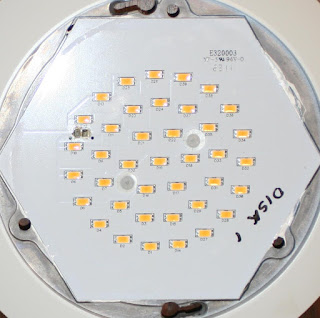 There is an array of twenty nine little LEDs, and surprising hand marking. This light was manufactured in June, 2011, early in production, where first sales were in September, 2011.
A wet white grease thermally couples the diode plate to the metal body of the light.
I won't throw this away. I have offered it to a friend, who will solder on new leads, and run it in a 24 vdc circuit. There is so much good workmanship to be honored. This is so much more repairable than an iPod.
Here is the back-side view of a 6B Glimpse light:

I won't ruin a good light by detaching the lens. Yet, I am able to make some comparisons to 6A.
The LED array is quite different, probably brighter and fewer diodes. All LEDs fit on a circle the diameter of the power block. Note four oval half-inch holes, where you can reach through and touch the inside of the lens. In some installations these holes might admit bugs. In a perforated can light or poor junction box, light may show in an attic floor or dark ceiling cavity, a magnet to bugs. Holes for ventilation? I don't think so.
At 4/30/2013, edit for the text now maroon. Some LED lights do not attract bugs. I can't remember a bug ever flying at these lights. I must do and report on, some careful observation.
I wish LSGC would promote public excitement about these lights. A sleepy marketing process through commercial distributors has failed them. Buyers will not accept multiple markups of thirty percent, in any consumer product. We need these lights, at lowest-possible cost, in very large quantities. In deserved frequent design upgrades, let there be trial of full-spectrum lighting, with a distribution of phosphor colors. (Is it simply variation in phosphor thickness?) Where a light will long outlive a cat, it should be of correct color. Wiring now as DC must be no big deal, allowing full control of humming complaints where dimmed.
6A is on the left. 6B, the only revision I am aware of, is on the right.

In the 6A failures, both were in the rather flimsy wiring. In one, the ultimate DC connector at the metal back, came off in the necessary step of squeezing and uncoupling the little black quick connector. Resetting the connector receptacle half with epoxy didn't restore electrical contact. In the other, the plate and its connector are good, but something is wrong in the two-block power converter. I can't ignite the light by wiggling wires, but surely the lost connection is in the wires, not inside the blocks.
I have at last drilled out the three posts securing the lens to the plate, of the light with the failed connector. The posts are held by Starlock fasteners, removable only by destruction.
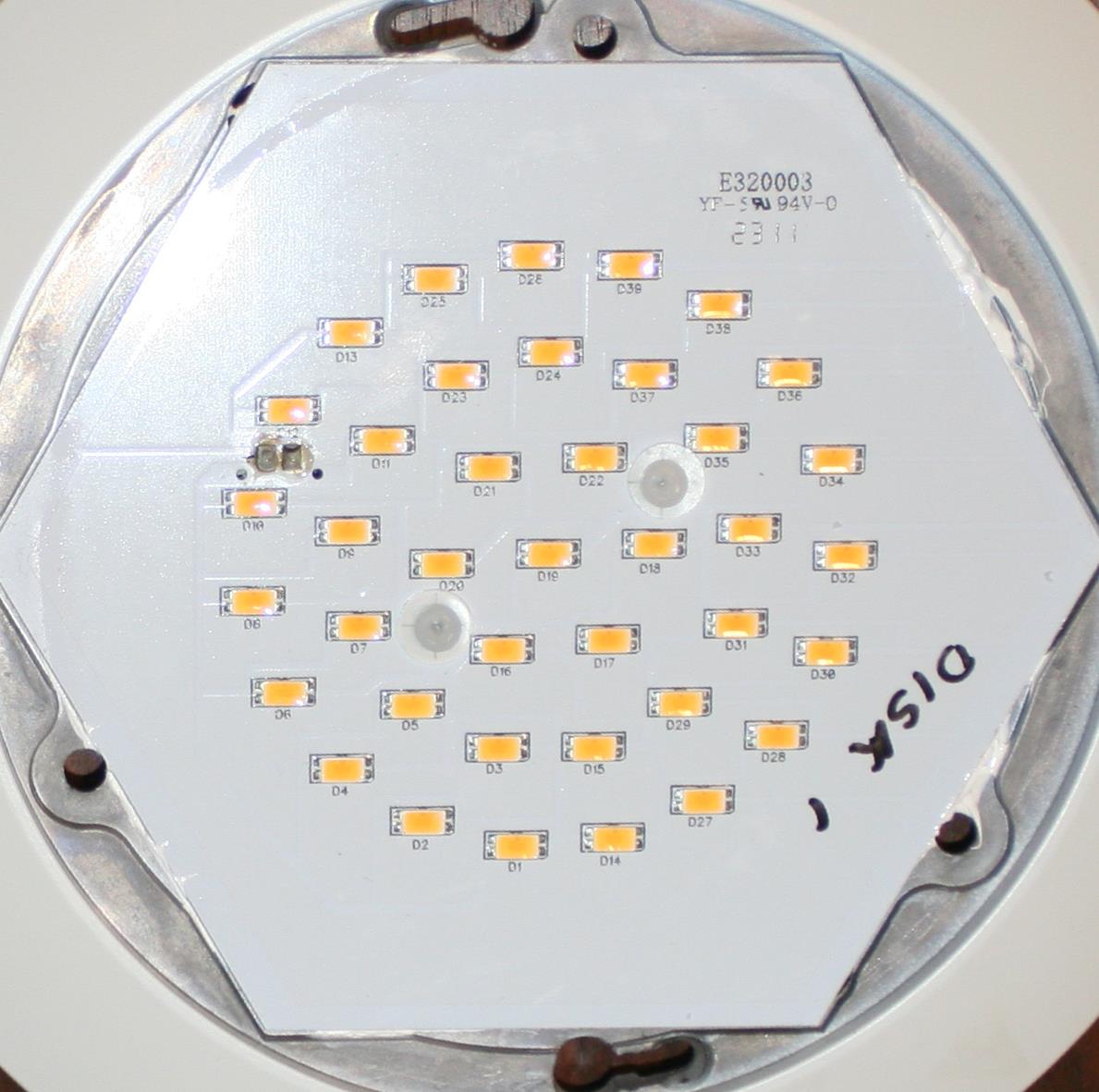
A wet white grease thermally couples the diode plate to the metal body of the light.
I won't throw this away. I have offered it to a friend, who will solder on new leads, and run it in a 24 vdc circuit. There is so much good workmanship to be honored. This is so much more repairable than an iPod.
Here is the back-side view of a 6B Glimpse light:

I won't ruin a good light by detaching the lens. Yet, I am able to make some comparisons to 6A.
The LED array is quite different, probably brighter and fewer diodes. All LEDs fit on a circle the diameter of the power block. Note four oval half-inch holes, where you can reach through and touch the inside of the lens. In some installations these holes might admit bugs. In a perforated can light or poor junction box, light may show in an attic floor or dark ceiling cavity, a magnet to bugs. Holes for ventilation? I don't think so.
At 4/30/2013, edit for the text now maroon. Some LED lights do not attract bugs. I can't remember a bug ever flying at these lights. I must do and report on, some careful observation.
I wish LSGC would promote public excitement about these lights. A sleepy marketing process through commercial distributors has failed them. Buyers will not accept multiple markups of thirty percent, in any consumer product. We need these lights, at lowest-possible cost, in very large quantities. In deserved frequent design upgrades, let there be trial of full-spectrum lighting, with a distribution of phosphor colors. (Is it simply variation in phosphor thickness?) Where a light will long outlive a cat, it should be of correct color. Wiring now as DC must be no big deal, allowing full control of humming complaints where dimmed.
Sunday, March 10, 2013
Review, Home Depot/ CREE T47 LED Disk Light
T47 LED disk lights still are not sold at my neighborhood Home Depot. Another store in Portland, Oregon, had several on shelves and in a display, with no fanfare.

The T47 and T67 differ mainly in rim diameter.

Inside, they have identical LEDs with 2700°K phosphor.

Identical LEDs are confirmed by the power draw, each at 12.5 watts without dimming.

The lumen number difference is real, where more-foolish diffuser angle throws away more of the available light with the T47. If the T67 is Brightness Number 5, equal in brightness to 125 watt incandescent, the T47 is 600/650 times B5, or B4.6, 115 watt incandescent equivalence. The steeper diffuser (same depth with smaller diameter) throws away another 8% for total of 18% efficiency loss, in the vanity of recessing the diodes. I now call the alternative lighting, not recessed, Projecting Planar Lighting.
With identical diodes and drivers the lights have identical and unacceptable hum, where tried with a dimmer (Cooper D106P tried). I wonder how many T67s and T47s have been shipped from China, with such degraded value where their brightness calls for dimming in most installations. How stupid that we don't make these lights within local markets, where error may be correctable, in limited trial production. Stupidity is accused against investor forces welcomed by government, that reward, not punish, export of jobs. Perhaps there is an energy loss in all stupidity, here delay of conservation efforts.
I have no use for these CREE lights despite some cute features as noted in T67 review. I have a T67 installed for a customer, over a kitchen sink, where the brown color temperature is noticeable, and the greater brightness of a 6" Glimpse is needed while working. I do like the clips that grab the ID of the found 6" can light. This can is missing features to pull up a Glimpse. Replacing a can light with a junction box is a hard sell, where the ceiling is not an attic floor.
Like Glimpse, the CREE lights include some wasteful hardware and are in elaborate and expensive display packaging. With the CREE lights it is difficult to reassemble in packaging for return with the humming complaint. We need to greatly reduce costs in Contractor Packs of better LED surface mount lights. If used in a noisy environment or without dimming, even T47 or T67 already are a better value than any light bulb, including any CFL. It is so important that we get this right quickly for a weatherization campaign, and we are so close.

The T47 and T67 differ mainly in rim diameter.

Inside, they have identical LEDs with 2700°K phosphor.

Identical LEDs are confirmed by the power draw, each at 12.5 watts without dimming.

The lumen number difference is real, where more-foolish diffuser angle throws away more of the available light with the T47. If the T67 is Brightness Number 5, equal in brightness to 125 watt incandescent, the T47 is 600/650 times B5, or B4.6, 115 watt incandescent equivalence. The steeper diffuser (same depth with smaller diameter) throws away another 8% for total of 18% efficiency loss, in the vanity of recessing the diodes. I now call the alternative lighting, not recessed, Projecting Planar Lighting.
With identical diodes and drivers the lights have identical and unacceptable hum, where tried with a dimmer (Cooper D106P tried). I wonder how many T67s and T47s have been shipped from China, with such degraded value where their brightness calls for dimming in most installations. How stupid that we don't make these lights within local markets, where error may be correctable, in limited trial production. Stupidity is accused against investor forces welcomed by government, that reward, not punish, export of jobs. Perhaps there is an energy loss in all stupidity, here delay of conservation efforts.
I have no use for these CREE lights despite some cute features as noted in T67 review. I have a T67 installed for a customer, over a kitchen sink, where the brown color temperature is noticeable, and the greater brightness of a 6" Glimpse is needed while working. I do like the clips that grab the ID of the found 6" can light. This can is missing features to pull up a Glimpse. Replacing a can light with a junction box is a hard sell, where the ceiling is not an attic floor.
Like Glimpse, the CREE lights include some wasteful hardware and are in elaborate and expensive display packaging. With the CREE lights it is difficult to reassemble in packaging for return with the humming complaint. We need to greatly reduce costs in Contractor Packs of better LED surface mount lights. If used in a noisy environment or without dimming, even T47 or T67 already are a better value than any light bulb, including any CFL. It is so important that we get this right quickly for a weatherization campaign, and we are so close.
Friday, February 22, 2013
T67 and T91/ Glimpse LED Lights Dimmer Video
This week I received twelve T91 LED lights, found in listing at ebay. At a price of $24.95 each and with free shipping, I was willing to take a chance on these "surplus" lights, not in original packaging, origin not explained. The ebay listing by New Life Electronics is regularly renewed, with seemingly an unlimited supply. In the box there were six of the original T91/ Glimpse design, and six of the current, improved design.
With these lights, and with six T67s in addition, I am able to expand understanding of how LED disk/ plate lights behave when operated on a dimmer.
Here is a video of the operation of sixteen LED disk lights in parallel, controlled by one Cooper Wiring Devices D106P dimmer, Sixteen In Parallel.MP4

Here is a back-side comparison of original and current T91/ 6" Glimpse lights:

Here are some conclusions from this testing:
I suggest there has been only one change of the 6" Glimpse/ T91 design. Please see my post, where I comment on visible differences. I call the two versions 6A and 6B.
With these lights, and with six T67s in addition, I am able to expand understanding of how LED disk/ plate lights behave when operated on a dimmer.
Here is a video of the operation of sixteen LED disk lights in parallel, controlled by one Cooper Wiring Devices D106P dimmer, Sixteen In Parallel.MP4

Here is a back-side comparison of original and current T91/ 6" Glimpse lights:
Here are some conclusions from this testing:
- The number of lights that may be operated from one dimmer is limited by the wattage rating of the dimmer. A 600 watt dimmer can operate forty 15 watt luminaires, carrying five amps.
- The original T91/ Glimpse with two clunky power blocks is unacceptable on a dimmer, if there is more than one light. If you buy via the ebay link and intend to dim, demand newer version in communication with the seller. I think I got as many of the older version, as the seller thought I might tolerate.
- One of the six older T91s failed in minutes of testing, never to fire again. This is the second failure of this kind I have seen. This is another reason to refuse buying the older version. I doubt I have recourse now, with the seller. I will want to break apart and examine one of the failed lights. I wish failures and fixes were freely discussed by manufacturers and their major distributors.
- I had claimed the newer T91/ Glimpse has been cured of humming in a dimmer circuit. Not so! I have just never been able to hear the hum from any distance.
- Seven T67s I have tested now on dimmers, have identical and objectionable hum, in a dimmer circuit. It isn't a simple problem. LSGC did not in fact find a cure for Glimpse. Some smart person could figure out why the Glimpse lights make less noise. It may be a subtlety of mounting provisions and structure natural frequencies, vs. the AC power at 60 Hz.
I suggest there has been only one change of the 6" Glimpse/ T91 design. Please see my post, where I comment on visible differences. I call the two versions 6A and 6B.
Subscribe to:
Posts (Atom)