Translate

Showing posts with label Lens Littering Of Dead Bugs. Show all posts

Wednesday, March 14, 2018

Review, GM Lighting S4 4" LED Disk Downlight, Driver On Board, Sold At Amazon


Don't go here!

GM Lighting - 4" Round LED Surface Mount 3000K 90 CRI Fixture White 

This looked to me, like Glimpse and Nicor DLS10, a reversion to junction box mating with screws revealed under a pretty access ring. I should have known better, where it is described as "driverless", then some cheap stamped-pan thing. 


As a dutiful reporter, I did show respect for yet another Amazon offering of a seemingly pretty LED disk downlight. The Amazon asked price is $24.95. I got a tempting better deal at Bees Lighting , $19.80 and free shipping. I should now be grateful and uncritical.


This is not offered with hardware to clip into a can light.


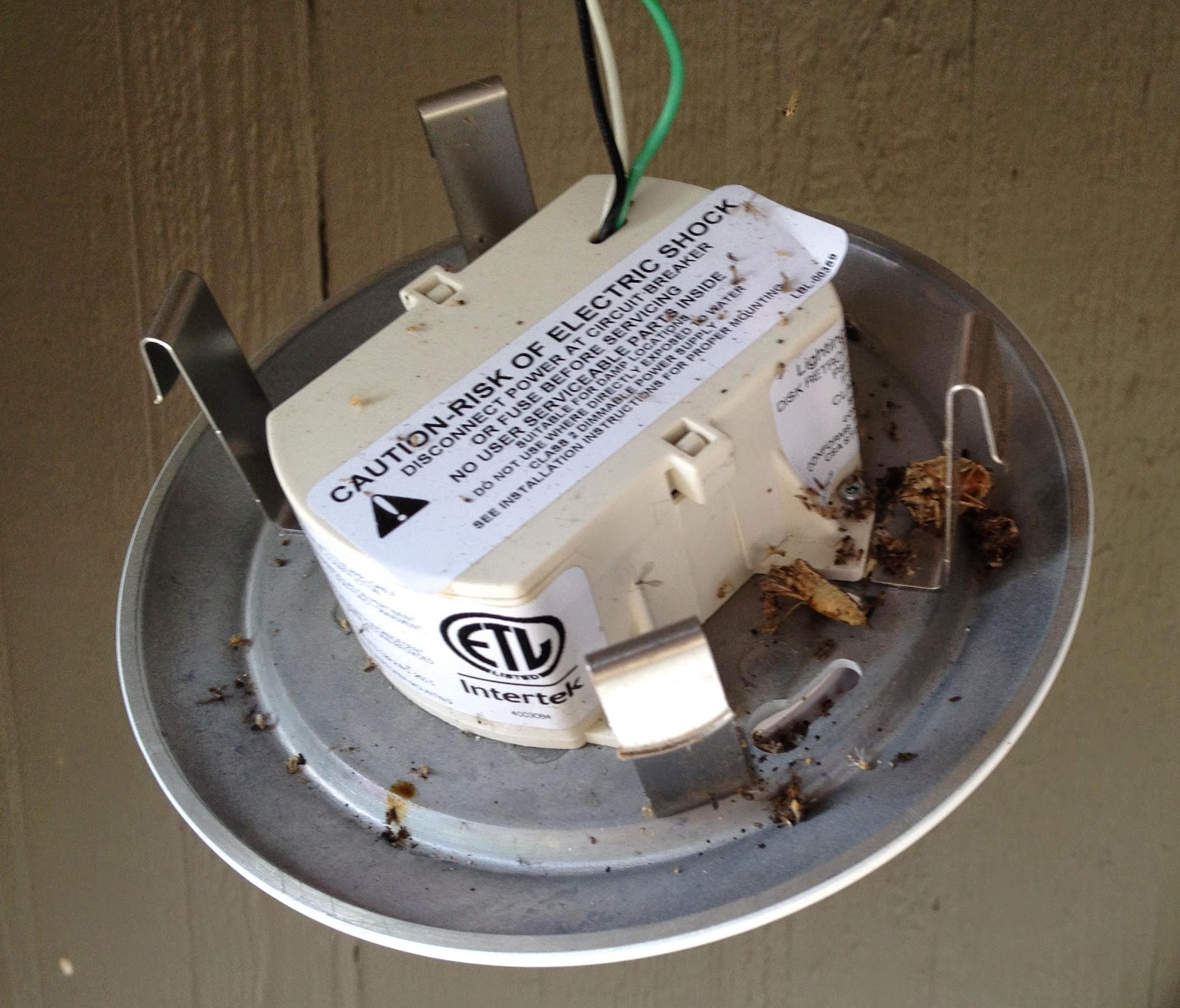
See the many slots that will be unprotected against intrusion of light-seeking-always bugs, to die in a pile of litter upon a loosely-attached obscuring lens. An informed installer might tape over the screw keyways. The large openings of lens keyways CAN NOT BE BLOCKED. Seal the junction box air tight, as I do, or don't install such cheap lights.


Keyways for box screws are at small 2 3/4" pitch.  Boxes with the small screw pitch are the most likely to be badly installed, with large visibility of spilled light.


Take this side by side comparison as confirmation of GM S4 claimed brightness and color temperature.


If glare numbers were required in advertising  and on packaging, the mindless degradation since Sylvania 70732 v1,  might have been avoided.

Thursday, December 21, 2017

Review, Westgate 4" LED Retrofit Kit

Do you want something better than this in your closets and hallways? You must, as a matter of safety and compliance with building codes, even though your hardware store may sell only the bare bulbs and cheapest porcelain fixtures.


For much of 2017, your choice as an Amazon shopper might have been 4" GetInLight . 

An eternal hallway night light:

This 4" GetInLight draws 9 watts to produce 550 lumens, double the downward illumination from a 60 watt incandescent dimbulb. Adjusted to equal illumination, the bug-proofed GetInLight draws 4.5 watts, a reduction of more than 90%. That is nearly the full savings that is achievable with LED lighting, easily available now. This will shine on for at least thirty years with no need of maintenance, if AC Driver On Board lights are as durable as external converters of DC LEDs.  Here over a guest bedroom door as a night light, the achievement is safety. There was no light here before.


On a bug-proofed RACO 175 junction box, 4" GetInLight draws up to gasketed sealing, via an awkward adapter ring. GetInLight has been a worthwhile nuisance, for lack of the adapter plate now included with a nearly identical 4" Westgate LED. Exactly identical boxes are the clearest indication GetInLight and Westgate are made in the same China factory. Amazon is the actual importer. Westgate and InLightMotion don't manufacture anything.


As an Amazon shopper in December 2017, you will find the Westgate now reviewed here, a better light and a better deal than the slimmer, more sleek GetInLight still offered at Amazon:


Westgate 9W 4" Dimmable Disk LED Surface Mount Disc Downlight Kit Accessories Included - Spun Aluminum Housing - Energy Star Rated - 550-600 Lumens 120V (1, 3000K Soft White) 
Your cost: about $14. Go for it. With the Seoul Semiconductor Driver On Board, it will readily mount to any ceiling junction box, however overloaded with wiring and however unsafe from overheating of wires by those 100 watt or bigger bulbs you can't buy anymore. You want more light. You want safety. You want to do your part saving energy and money.


Here see the important box adapter plate that Amazon fails to ship, with GetInLight. See the very many paths that glow brightly within a can light or junction box, impossible of sealing. A bug entering the junction box will certainly die upon the luminaire lens, seeking and never finding, the heaven of diode contact. This is my typical installation on a sealed-bug-proof RACO 175 steel junction box. The deep RACO 175 boxes have been necessary for LED disk downlights with a bulky external driver from house AC power. See that even with the adaptable and rugged RACO 175, caulking is needed to keep bugs out.


Please find my positive review of this light as a Google Photos Album . Know right away that you must do better than the simple adoption suggested so far. Wiring with decrepit electrical insulation must be replaced. If your junction box is old and leaky or if you stuff this into a 4" can light, you will be happy, for awhile. Then you will see the lens darken from litter of dead bugs. LED lights do attract bugs, especially where seen from the ceiling interior as bright points, the stars that denote vertical wrongly and then madden.

Get used to LED disk downlighting. It doesn't look like your bulb, but it lasts forever, and saves more than 90% in operating cost versus point-source incandescent. Few of us have tried these, but they are our illumination of the future. We quickly see them as beautiful, and that will be especially true of the shapely little Westgate light

The Westgate-included adapter plate at the back side is released from the luminaire assembly and becomes part of the ceiling interface. Keyways in the luminaire are at 2 3/4" pitch, and the adapter plate reaches out to 3 1/2" pitch more-commonly found.


Now consider Westgate luminance (glare) numbers. Diode luminance and array luminance are both small compared to a glaring light like Nicor DLS4.


Assess brightness of the Westgate LED, comparative task illumination at my comparison stand. During evaluation of an EiKO LED edge-light, compare several LED luminaires stage left, against a 100 watt point-source incandescent bulb at stage right. The point source bulb is that still legally sold, Philips EcoVantage 1490 lumens, 72 watts. Choose LED luminaires of 3000° color temperature with large beam angle typically 120°.

4" Glimpse of 2013, called 450 lumens, at left. Philips EcoVantage "100 watt" bulb at right. I have made this comparison many times, always finding equal brightness and slight difference of color temperature with bulb nearer 2700°K. I call both "B4", by definition. This is the brightness by which very many homes with 8-foot ceilings have set luminaire spacing. B4, about 500 lumens, will be the goal in usual LED swaps for closets, narrow hallways and small bathrooms. In larger rooms with want of productive activity, we will want more than B4 in swaps upon existing junction boxes. More light is good.


The luminaire at left in this photo is Westgate 4". The Westgate is only a bit brighter. I have found in very many comparisons that a "100 watt" bulb gives task illumination comparable to a LED disk of about 500 lumens with about 120° beam angle. Question that the Westgate is 600 lumens.


Now Westgate 4" LED called 600 lumens is at stage left. Eiko called 650 lumens on its box front is at right.  The Eiko is identified as 800 lumens in its Lighting Facts label.


Saturday, October 28, 2017

Best World LED 1100 Lumens, 3000°K, 15 Watts, Amazon Purchase, Reviewed


Price $39.99 and free shipping Amazon Prime. $10 each for a pretty light that may be installed most anywhere, by anyone. It is the promise of LEDs that can reduce operating cost more than 90% vs. incandescent bulbs, delivered, if perhaps too cheaply. Dimming is imperfect, and this has only a three-year limited warranty, with no claim of expected operating hours. Do buy it if you want real, efficient light, getting rid of silly point-source incandescent and under-performing CFL and LED lightbulbs that might reduce operating cost only 75%. The added conservation is important. Get used then, to downlighting everywhere. Don't want recessed lighting. We know not to stare at brightness that lights our homes.

Find photos at the Amazon link, including this:


This is really-efficient packaging. Not even tape to slice.  I've wondered about cost in shipping volume and some added weight, of container boxes. I have supported the efficiency, accepting delivery to Amazon Locker. If I wanted a return, I could print covering shipping labels. I do not want to return this.


Four attachment kits, together, protected against scratching luminaires.


And the luminaires and instructions. The instructions are printed 8 1/2" x 11" USA dimensions and are legible.


There are discreet OPEN -CLOSE arrows at edge of the lens. You will only be glad, to have them.


This is the entirety of the electronics. Is there something fragile here, that reduces this light to a limited three-year warranty, stated on the box?


At stage left on my comparison stand, a Best World LED, claimed 1100 lumens. At stage right, 1022 lumens Nicor DLS56. Both are claimed 3000°K. I attribute the less-pretty Nicor illumination to actual color temperature of under 2900°K.


Both lights work fairly well on an inexpensive Cooper DAL06P dimmer from Lowe's. The Best World light drops off quicker, and both are nearly dead at about 10% power. Choose a dimmer with range setting to avoid the shutoff.


There are many provisional openings through the luminaire. All but the usually-employed keyways at 3.5" screw pitch are covered with metalized-plastic tape that lets through quite a bit of light. Bugs able to pass through or around the junction box will be crazed by the keyway light leakage, then littering the lens. Know to tape over the keyways and mated screws before resetting the lens. Use white or reflective tape, hoping to not contribute to light-off lens darkness. But, instructions don't warn this. For this instructions deceit, I will knock off one star in my review at Amazon. I believe the manufacturer knows better.


I have really missed low-glare Cost Less 6" LED, discontinued in the interest of offering something cheaper with another nickel in retailer profit margin intended. The Best World LED gives again, decent low glare, but it might be less durable, and it IS worse in dimming. Was cheapening worth it, for customers with can lights, or boxes not overloaded, who did not mind AC/DC converter blocks perhaps more durable?


At 11/20/2017, this post has edit of the luminance table above, to include yet another China offering via Amazon, Jullison LED, Hong Kong . This time there is no pretense the push to USA of products conceived in China with susceptibility to bug littering of lenses, has any USA sponsorship. Jullison packaging and the Amazon listing are silent on durability of the AC LED circuitry. If these last only three years, they are not good value.

The clear acrylic over diodes is on legs, and itself can collect determined bugs.


The Jullison offering does not deserve separate review. The world does not need this light, with larger diode glare and impossible of blocking bugs at the lens attachment keyways. I will return the light as defective and will offer a negative review at Amazon. The review is largely a criticism of Amazon, who takes full responsibility for the offering. I think Amazon should somehow warn shoppers. My review if accepted, is one-star. I would agree that is harsh for a decent light that saves energy, but I hope to get the attention of shoppers and of Amazon to design against bugs, in lights that should otherwise never need service with attendant dangers. One danger here is in the random stiffness of lens attachment keys. Palm friction sometimes is inadequate, and turning direction marks on the lens are barely visible. Will one clean out bugs with a hammer or a chisel? 

Monday, May 8, 2017

An Easiest Overhaul Of Dead T12 Fluorescents In A Kitchen

This post converts content of a Google Photos Album , to blog format.

These T12 fluorescent lights buzz loudly, and two of six 30 watt tubes are dim. I will find that two of the three heavy ballast units are oozing nasty PCBs. Power consumption is not just the tube draw. From the blog of Hovey Companies in Michigan , now Windemuller , find that total fixture draw of each eight-foot unit is 178 watts. Draw with dying ballasts is perhaps more. I might fix the buzzing with new ballast units, $38 each at Home Depot, and preemptively relamp at $5 per tube, perhaps giving another fifteen years of fixture service interrupted only by annual take-down of dead flies and stink bugs littering the plastic lens panes.

The home owner knows I have a better solution that costs no more. I have similarly replaced T12 fluorescent fixtures in two bathrooms.


It has taken two hours to demolish the found fluorescent fixtures and to install six Lithonia 7" LED Versi Lites , each 10.2 watts, 640 lumens, 3000°K color temperature. The LED disk downlights are attached to drywall with 1 1/4" drywall screws and are directly powered by 120 VAC (AC light engines) via 18 gage conductors. I failed at this installation, to seal ten half-inch holes in the drywall, but returned a week later with a better notion of the importance of that sealing. These holes for toggle bolt screws are little obstructed by steel bodies of fluorescent fixtures, and were the path a big stink bug could crawl through, for forty lens-littered years. A stink bug could not crawl past a lens or through small gaps above fixture aluminum frames.


The revived and silent lighting is much brighter. Total power draw is now 61 watts maximum, and will likely be dimmed much of the time, to less than fifty watts. This peak power consumption is down from 534 watts (or more with failing ballasts), a more than 90% reduction. Assume this condition is maintained fifteen years maintenance-free, before an anticipated grand kitchen overhaul where lights still have $30 value each, then used elsewhere. Assume an alternative miserly life with lights on just three hours per day if still non-dimmable fluorescent. Assume cheerful eight hours per day usage as LED with dimming to average 60% power, 300 watt-hours per day, 365 days per year. Saved electricity is 365*(3*534 - 300)/1000  = 475 KWH, a first-year savings of $52. A perpetual energy savings of $52 per year has fifteen year present value of $1352 if energy cost grows at 10% per year vs 3.2% general inflation and 5% annual interest cost of money if borrowed. I charged $240 for the job, better-compensated in friendship cemented with gift value of more than $1000, and expected enjoyment of a brighter buzz-free quality of life.


If I had only overhauled the found fluorescents at cost of $120 for new ballasts and $30 for new tubes, for the same $240 job cost, I would have robbed this friend of $1000 and diminished her quality of life. Fortunately, I know to do better. Now, do you?

Do know, I would be an even better friend in a kitchen overhaul now, where I would better light up the kitchen with visible LED disk downlights more pretty than Versi Lites and bug free forever. The current-best offering in this would be Lighting Science 6" Glimpse. The better light might be like this at another home in this wonderful Lake Oswego, Oregon condominium complex, soon to be my home:

Monday, June 30, 2014

3000°K LEDs Do Attract Bugs

I have ended nearly a year of wishful thinking that LEDs might not need to be sealed against admission of bugs, determined to be guided by a fragment of starlight. 4" Glimpse, except poorly sealed against bugs, seemed a wonderful replacement for 50-watt halogens, dead in cans, on front soffits of an upscale 1998 home. Such an easy way to improve a home, with more than 80% reduction in energy use.


This is the usual appearance of the halogen can. Dead.


This is appearance with a 9.5 watt 4" Glimpse can retrofit, a jewel in early-morning light. I have recklessly done these difficult second-story replacements having no light to use, but 4" Glimpse.


So pretty!


Now I must take off the blinders, and be responsible for what I have done. After eleven months, five first-floor soffit lights all have brown peppering, clouding still-pretty lenses.


Yes, bugs are compelled to find that guiding light.


Quite a collection on the rim and lens!


Big bugs died too, seeking the light, including a pesky attic-dwelling stink bug and a cricket.


I am liable for what I have done, knowing better, and have promised to take back the 4" Glimpse, mostly at my loss, when a better product arrives. I continue to buy 4" Glimpse, with great restraint. I will not again install one outdoors. Where lights will last a lifetime, it is worse than absurd, to use them in a way that commands difficult annual maintenance. 


A message then to lighting manufacturers: don't leave paths to be explored by bugs. Most lights I will use do well in this. Lighting Science Group, please fix and upgrade diode boards in 4" Glimpse. Your four-year old product deserves to be killed by a little competition.

And now after dispensing more anger against manufacturers who don't constantly improve their products in a time of rapid evolution, I see I have overlooked my ticket out of trouble in this job. I needed only two strips of my Nashua Foilmastic tape over the two keyholes, to cover the light leaks. I will go back immediately, and fix all ten lights. I will stop thinking maybe there is an A19 LED light bulb that would have been a better retrofit. All cans, be damned!


Thirteen days on, I am taking down all ten exterior soffit 4” Glimpse lights, to cover slots that attract and admit bugs, applying strips of Nashua 367-17 foil-mastic tape. This is the fifth of five treated this morning, twenty five minutes into the task. Now-practiced, I will photograph the process. Thirteen days of bug accumulation is large, already visible as browning of the lens.


Lots of little bugs in just thirteen days!


The dusted and reassembled light is sealed with ~1” strips of Nashua 367-17 tape. Tape adhesion seems fine and durable on these new surfaces. Adhesion will be much less satisfactory on year-old surfaces, perhaps plasticized by bug traffic.


For Glimpse lights installed at first-floor level a year ago, I attached the green tethers. That attachment is now a nuisance. I will detach the tethers to take down lights, and will not reattach them. Note the can light hacking of soffits to 6 1/2” diameter. What a shame. In the future, penetrations will be minimal, in low voltage DC circuits. A house will last much longer than technology in its lighting.