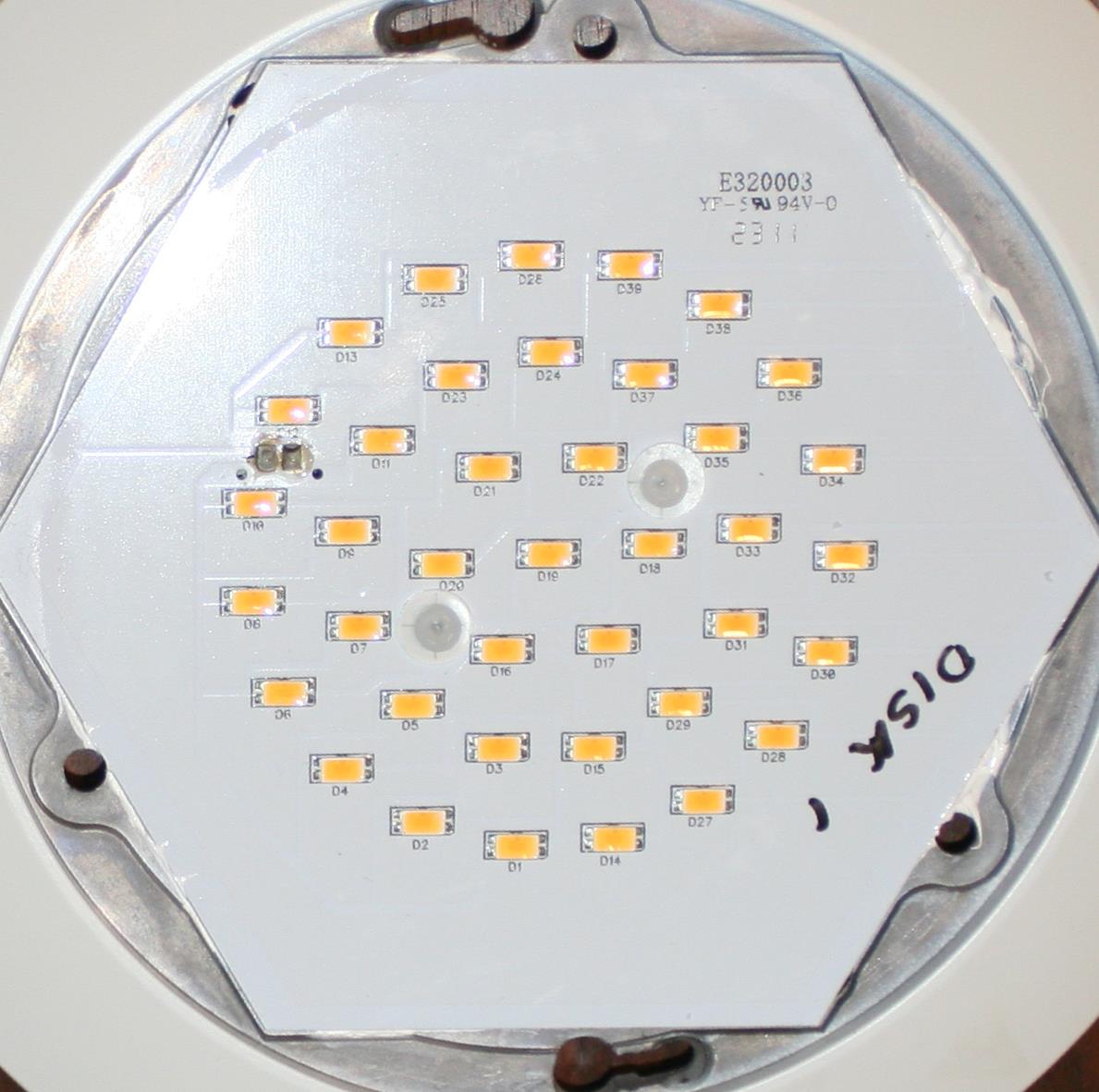
I walk the light bulb and recessed lighting rows at each visit to Home Depot, looking for something new. I don't know where else to see emerging LED technology. Yesterday, I picked out an example of a bulb-form LED that may fully reveal the light. There may be other LEDs for sale with full reveal where mounted in a can, but I don't yet see them. Salespeople don't understand my interest.
Knowing I would only test this light, I bought one that had been cut open.
Marking resembles that of now-gone T91. Same wrong 75 watt incandescent equivalence.
This is made in Mexico, for Home Depot, with bar code 74340 00111, and model ID 409 440.
I paid $24.97, relatively cheap. And, it is available now. But, beware loss of light where this fairly short bulb is recessed in a can. A short can might display all light. Much is lost as with all flood bulbs, where the bulb is deeply recessed.
I admit uncertainty what is under the glass dome. Surely it is a flat array of LEDs, that are fully displayed, surface mounted, if the glass projects from the ceiling.
14 vs 14.5 watts power draw, 800 vs. T91 at 750 tested lumens.
LED bulb on the left, Philips EcoVantage 100-watt equivalent incandescent on the right. I'll give the LED Brightness Number 7. That's from accepting that stated lumens on a package are correct, and a standard of B6.7 for a straight-on 750 lumens 6" Glimpse/ T91. Then 800/750*6.7 = 7.1.
Start with definition that a 100 watt incandescent with all of its spilled light, is B4. The incandescent is truly a point source, the bygone concept of an electric candle. Then, know that narrowing a light beam is generally not helpful. Let it fall straight down, or perpendicular to an illuminated surface, without focus. I judge that the LED flood has a flat plate of diodes on the plane backing the frosted lens. All light is revealed.
Here a 600 lumens T47 is at the right, propped-up over the junction box and more-distant from the wall. B7 vs. B5? Same color temperature. I have guessed at 82% light transmission with the recessed diodes of the T47.
0.82 * 600/750 * B6.7 = B4.4. Not B5? I admit here that this side-by-side comparison does not discriminate against recession of diodes, light at periphery not revealed. Official definition of Brightness Numbers as task illumination, will have complexity. I'm a little glib. Those applying lumens as brightness measure are irresponsible, perhaps willfully placing disadvantage in plate LED packaging. There is irresponsibility too, in not rating a bulb in a needful fixture that blocks revealed light.
All observed lights here are powered through a Cooper D106P dimmer, full-on. Buzzing? Yes. I haven't learned to rate noise, but here is a try. If T47/ T67 is level 10 on a linear scale, the LED bulb is 5. A 6" Glimpse is 3.
At end-October 2013, this post is edited as I update all of my blog posts, to replace phrase "plate LED," with phrase "surface mount LED." Phrase Plate LED is confused with license plate lighting, and is not accepted elsewhere as a brief statement that the luminaire may be wired directly into a junction box. In my definition, a plate LED is surface mounted, not recessed for foolish styling reasons, to look like a can-mount downlight. Can-mount downlights were a consumer adaptation of theater downlighting, where upon a black ceiling, there is nothing bright to divert attention from a stage. In any circumstance other than a stage center, there has never been a bit of virtue in recess setting of a light. It has been quite disastrous in our waste of the Earth's ready fuels, that many have loaded their can lights with bulbs that are simple point sources, with no reflector bouncing to usefulness, the light that otherwise does not beam downward; all such light and heat energy, totally wasted. Look for all content of this paragraph, and more, in a new blog post under construction. While I edit out the phrase LED Plate Light, I retain the label, temporarily. "Labels" are noted at the bottom of all blog posts, for collection of related topics of interest to a reader.
As a contractor, I have installed Glimpse LED lighting, proudly and with confidence. I have reported two failed lights in about six dozen experienced so far. Both were with the initial design of these lights, I will call Glimpse 6A.
6A is on the left. 6B, the only revision I am aware of, is on the right.

In the 6A failures, both were in the rather flimsy wiring. In one, the ultimate DC connector at the metal back, came off in the necessary step of squeezing and uncoupling the little black quick connector. Resetting the connector receptacle half with epoxy didn't restore electrical contact. In the other, the plate and its connector are good, but something is wrong in the two-block power converter. I can't ignite the light by wiggling wires, but surely the lost connection is in the wires, not inside the blocks.
I have at last drilled out the three posts securing the lens to the plate, of the light with the failed connector. The posts are held by Starlock fasteners, removable only by destruction.
There is an array of twenty nine little LEDs, and surprising hand marking. This light was manufactured in June, 2011, early in production, where first sales were in September, 2011.
A wet white grease thermally couples the diode plate to the metal body of the light.
I won't throw this away. I have offered it to a friend, who will solder on new leads, and run it in a 24 vdc circuit. There is so much good workmanship to be honored. This is so much more repairable than an iPod.
Here is the back-side view of a 6B Glimpse light:
I won't ruin a good light by detaching the lens. Yet, I am able to make some comparisons to 6A.
The LED array is quite different, probably brighter and fewer diodes. All LEDs fit on a circle the diameter of the power block. Note four oval half-inch holes, where you can reach through and touch the inside of the lens. In some installations these holes might admit bugs. In a perforated can light or poor junction box, light may show in an attic floor or dark ceiling cavity, a magnet to bugs. Holes for ventilation? I don't think so.
At 4/30/2013, edit for the text now maroon. Some LED lights do not attract bugs. I can't remember a bug ever flying at these lights. I must do and report on, some careful observation.
I wish LSGC would promote public excitement about these lights. A sleepy marketing process through commercial distributors has failed them. Buyers will not accept multiple markups of thirty percent, in any consumer product. We need these lights, at lowest-possible cost, in very large quantities. In deserved frequent design upgrades, let there be trial of full-spectrum lighting, with a distribution of phosphor colors. (Is it simply variation in phosphor thickness?) Where a light will long outlive a cat, it should be of correct color. Wiring now as DC must be no big deal, allowing full control of humming complaints where dimmed.
T47 LED disk lights still are not sold at my neighborhood Home Depot. Another store in Portland, Oregon, had several on shelves and in a display, with no fanfare.
The T47 and T67 differ mainly in rim diameter.
Inside, they have identical LEDs with 2700°K phosphor.
Identical LEDs are confirmed by the power draw, each at 12.5 watts without dimming.
The lumen number difference is real, where more-foolish diffuser angle throws away more of the available light with the T47. If the T67 is Brightness Number 5, equal in brightness to 125 watt incandescent, the T47 is 600/650 times B5, or B4.6, 115 watt incandescent equivalence. The steeper diffuser (same depth with smaller diameter) throws away another 8% for total of 18% efficiency loss, in the vanity of recessing the diodes. I now call the alternative lighting, not recessed, Projecting Planar Lighting.
With identical diodes and drivers the lights have identical and unacceptable hum, where tried with a dimmer (Cooper D106P tried). I wonder how many T67s and T47s have been shipped from China, with such degraded value where their brightness calls for dimming in most installations. How stupid that we don't make these lights within local markets, where error may be correctable, in limited trial production. Stupidity is accused against investor forces welcomed by government, that reward, not punish, export of jobs. Perhaps there is an energy loss in all stupidity, here delay of conservation efforts.
I have no use for these CREE lights despite some cute features as noted in T67 review. I have a T67 installed for a customer, over a kitchen sink, where the brown color temperature is noticeable, and the greater brightness of a 6" Glimpse is needed while working. I do like the clips that grab the ID of the found 6" can light. This can is missing features to pull up a Glimpse. Replacing a can light with a junction box is a hard sell, where the ceiling is not an attic floor.
Like Glimpse, the CREE lights include some wasteful hardware and are in elaborate and expensive display packaging. With the CREE lights it is difficult to reassemble in packaging for return with the humming complaint. We need to greatly reduce costs in Contractor Packs of better LED surface mount lights. If used in a noisy environment or without dimming, even T47 or T67 already are a better value than any light bulb, including any CFL. It is so important that we get this right quickly for a weatherization campaign, and we are so close.
This week I received twelve T91 LED lights, found in listing at ebay. At a price of $24.95 each and with free shipping, I was willing to take a chance on these "surplus" lights, not in original packaging, origin not explained. The ebay listing by New Life Electronics is regularly renewed, with seemingly an unlimited supply. In the box there were six of the original T91/ Glimpse design, and six of the current, improved design.
With these lights, and with six T67s in addition, I am able to expand understanding of how LED disk/ plate lights behave when operated on a dimmer.
Here is a video of the operation of sixteen LED disk lights in parallel, controlled by one Cooper Wiring Devices D106P dimmer, Sixteen In Parallel.MP4
Here is a back-side comparison of original and current T91/ 6" Glimpse lights:
Here are some conclusions from this testing:
- The number of lights that may be operated from one dimmer is limited by the wattage rating of the dimmer. A 600 watt dimmer can operate forty 15 watt luminaires, carrying five amps.
- The original T91/ Glimpse with two clunky power blocks is unacceptable on a dimmer, if there is more than one light. If you buy via the ebay link and intend to dim, demand newer version in communication with the seller. I think I got as many of the older version, as the seller thought I might tolerate.
- One of the six older T91s failed in minutes of testing, never to fire again. This is the second failure of this kind I have seen. This is another reason to refuse buying the older version. I doubt I have recourse now, with the seller. I will want to break apart and examine one of the failed lights. I wish failures and fixes were freely discussed by manufacturers and their major distributors.
- I had claimed the newer T91/ Glimpse has been cured of humming in a dimmer circuit. Not so! I have just never been able to hear the hum from any distance.
- Seven T67s I have tested now on dimmers, have identical and objectionable hum, in a dimmer circuit. It isn't a simple problem. LSGC did not in fact find a cure for Glimpse. Some smart person could figure out why the Glimpse lights make less noise. It may be a subtlety of mounting provisions and structure natural frequencies, vs. the AC power at 60 Hz.
I suggest there has been only one change of the 6" Glimpse/ T91 design. Please see my post, where I comment on visible differences. I call the two versions 6A and 6B.
Where the title of this post is also a blog-search Label, look for newest writing with the Label search .
I am pushing harder than ever to influence design of residential attic ladders, where my interest is entirely in wood ladders, whether with an ordinary insulated door, or a fire-rated door. Here is an example of what I am after, in a wished-for ladder from prominent supplier Fakro.
Apply the same principles in a ladder for more-ordinary ceiling height:
Our homes and our needs are so varied. I am able to, and do, customize a ladder for each situation. The first freedom taken, is in lengths of intermediate sections. The second is in setting the ladder angle as I choose, as shallow as possible down to about 60°. I think the ordinary ladder has four sections, of lengths to suit our peculiar needs, with full attention to individual comfort and safety. I have three respected suppliers for USA installation of products Fakro, Calvert USA, and MidMade. All of these suppliers offer out-of-the-box ladders of three sections, of equal or nearly-equal length, and with wood ladders set a fixed angle. They despair of serving the specific need of any end-user.
Landing to the floor within space available and avoiding obstacles, is the complex need. If you have begun and find a surprise, there must be a solution. If you could land the ladder more favorably at a steeper or shallower angle, you will want to. I speak mainly of an "unlucky bottom step", too close to the floor. Hit of a door header is another common unpleasant surprise. And, what if the bottom just doesn't quite reach the floor? With a hole in your ceiling, you must safely fulfill your commitment. There are supportive needs that will never be met by a big-box store or online seller, whether the product be that unique ladder, or bicycle.
I think attic ladders are similar in consumer demand, to bicycles. One size or flavor does not suit all. Besides facing unique needs, ladders are like bicycles in their fragility in shipment. Many manufacturers, and there are very many, serve only a local market. A manufacturer embracing bicycle-shop-like distribution, with safer and less-expensive shipping, could expand its market.
I have much more to say on this subject. Some of it is in the form of an open letter to manufacturers, as a page at my r5portals web site.
Versus point-source lighting, there is a beneficial shape factor of about two, for naturally-directional LED illumination. I have proven this in side-by-side comparison tests. It is explained here:
http://www.firefly-technology.com/resources/How+Bright+is+that+LED+Bulb.doc
This link leads to download of a Word document. If you prefer, view it online, attributed to Firefly, as PDF.
Since about half of the illumination from an LED chip array is lost in shaping as a point-source "bulb", there will be little use in the future for fixtures that present light as a point source. Directional light, then rated for illumination brightness rather than omni-directional lumens, will always be more efficient. It is the presentation of the light that matters, and there will be surface mount LEDs fed through A19 and other sockets, upon light cans and other fixtures.
At end of January, 2013, I recognize two good LED plate lights, produced by Lighting Science Group, as product Glimpse. Let us compare operating costs of Glimpse, and other currently-available lighting, unitized to Brightness Number 4, that of the old 100 watt incandescent light bulb. That is, for illumination other than B4, multiply costs and savings by the ratio (4/ Brightness number), for same-basis comparison. Where illumination from a given source location is increased, fewer neighboring lights are needed, or productivity improves in direct proportion. If you want that "100 watts", and a Glimpse light is brighter, you might dim it, without waste of energy in the dimming.
Here is a Table of luminaire cost and savings comparisons, adjusted to a common basis at B4, except that there is further economy in installation cost of surface mount LEDs. The table displays dollar value and greater carbon savings, taking credit for a brightness advantage of surface mount LEDs, vs. all light in bulb form. The listed CFL is not dimmable, and gives dreary light. I think its lifespan is very overrated. Surface mount LEDs do win over CFLs on lifetime cost. Bulbs that fail have additional cost disadvantage in matters of safety while dead or in replacement. Aren't we happy to now have mufflers that last the life of a car?
(The table has been updated 6/6/2013 to include important Sylvania LED Disk Lights.)
Well, now, how do those savings numbers compare to listings on packaging?
Package math is for electricity only, and credits the T91 as equal to a 75 watt incandescent. Savings:
35,000 * 0.11 * (75 - 14.5 )/ 1000 = $233.
I don't understand the sloppy math of this packaging.
Let me re-do my math of this T91, for electricity only, with brightness as of a 167 watt bulb:
35,000 * 0.11 * (167 - 14.5)/ 1000 = $587. There is more at issue here, than how to do math.
Package math is for electricity only, and credits 100 watt equivalence. Savings:
10,000 * 0.11 * (100 - 23 )/ 1000 = $85.
This isn't error. It is permitted propaganda.
Who is responsible for not standing up against deception?
Here are PDF albums showing installation of LED lighting in RACO 175 lighting junction boxes, in a new bathroom ceiling. I detail the procedure where one person does the work, with a few trips to the attic. Even with multiple workers, a safe attic ladder and attic lighting are important to getting the job done safely.
As a procedure for a 4" Glimpse LED plate light.
There is a single Romex power cable here twist-connected to the kit quick-connector. LSGC instructs removal of the ring terminal on the green fixture ground lead/ security wire. Why? I have here attached the ring terminal to an 8-32 fixture mounting screw. It will be better to "bond" the ring terminal at the box "green screw", if all attachment at the green screw is with ring terminals.
Where professional electricians become involved with a national LED conversion campaign, I wonder what they will bring to further evolution of the hardware.
As a procedure for a 6" LED disk light, Home Depot T67.
Please follow the link, for more discussion of grounding provisions and sensibility of hardware.
Please contrast this achievement of air-tight strong installation, to what most people will expect, using a plastic box in a T91 installation. Where a box is not solidly set in the ceiling, it is hard to complete a seal around it. The seal is less important than the reduced power draw, but it is silly to skip maybe 20% of the potential savings vs. poor incandescent lighting.