Translate

Friday, December 30, 2011

Q & A: Attic Walls

At the dawn of 2012, my web pages are drawing sometimes-daily email questions. I am resolved that these will be addressed publicly. This will be more-productive use of my time, and will justify more-thorough answers. Others may pitch in through comments, to contradict or add to the discussion. This exercise of the free resources of Google, will have interesting differences from a bulletin board, and from a web site forum such as the Q and A at greenbuildingadvisor.com. Let's see how Blogger serves us.


I am asked:
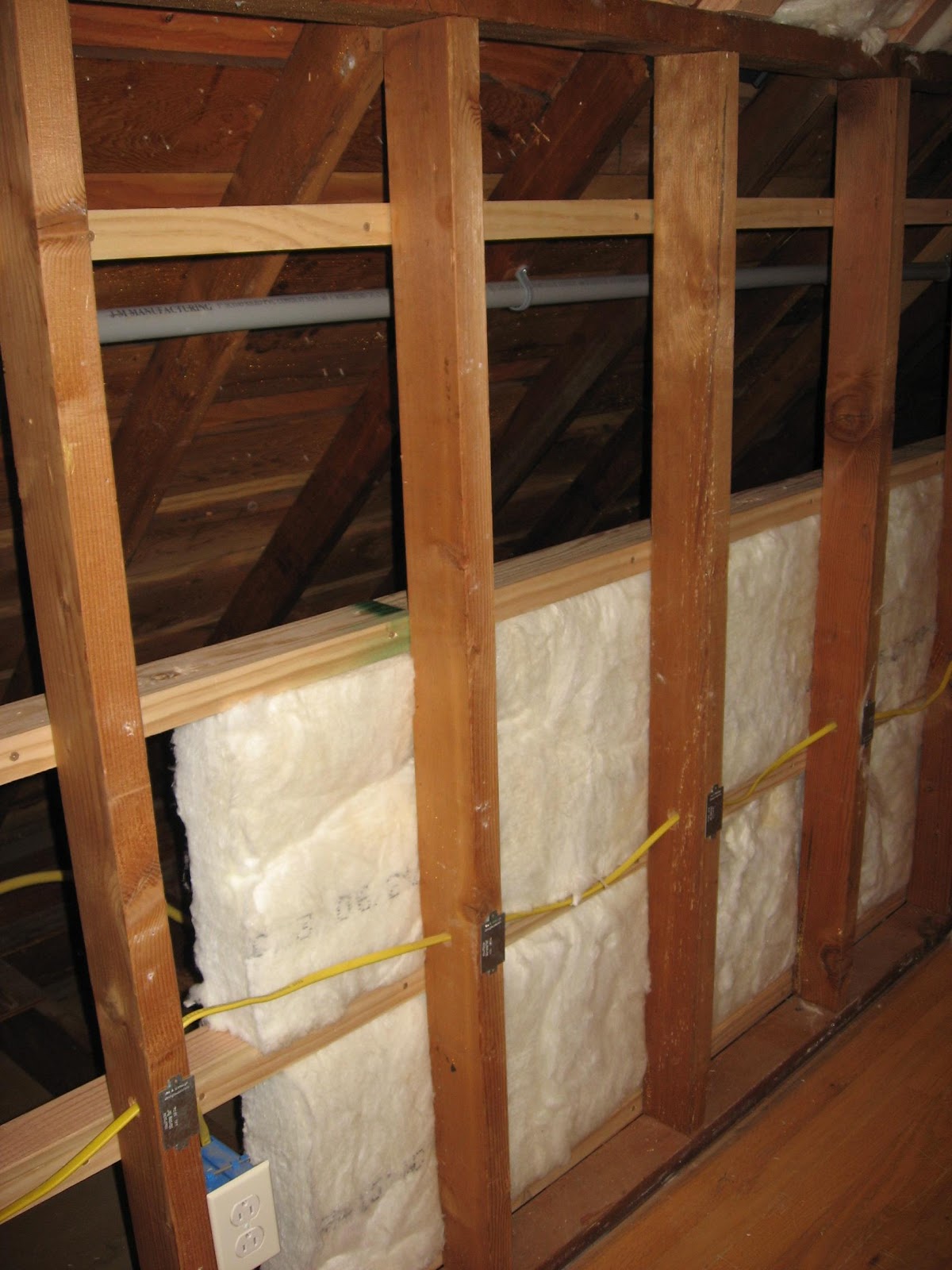
In my unheated attached garage there is old fiberglass insulation with kraft paper on both sides in a gable wall that joins the house and garage.   In the room in the house where this wall shares, the wall and the room feel cold during the winter. I would like to update and improve this wall's insulation and prevent wind washing.

How would you suggest I make this improvement?
This photo is included:


I respond:
To have any value, insulation must be packed against a convective surface. I'm guessing these are 2x4 frames, and insulation is R11. I have not seen this insulation marking before, and must accept your claim it has kraft facing on both sides. The hacked-off stapling tabs on the garage side might be an attempt to avoid working as a wrong-side vapor barrier. I wonder what now retains the batts. A kraft facing on the interior side would reduce wind resistance and further reduce insulation value.

I have considered the situation under a heading "knee walls", but from now on will use the label "attic wall", for both gable walls and closet knee walls dividing attic temperature from conditioned spaces. It will be an invention, like my naming of "attic floor pits", not yet in common use. Because of extreme summertime temperature differences, and because nothing prevents making attic walls thicker, they should have a better insulation requirement than walls exposed to outside temperature.

My advice is developed at my web site.

I have applied crossing R15 batts in 2x4 walls, with added horizontal 2x3 framing. After joist thermal shorting, each layer contributes about R11. I believe there is some added benefit in framing being full-depth only at crossings.


I show simple payback with the crossing batts, in three or four years. With space, have even more insulation. Construction in a gable or knee wall remodel could be difficult with added lumber heavier than 2x3.


Where there might be incentives for the better insulation, there should be no limit upon found conditions. In my area, a rebate is offered here in going to prescribed R15, only if found conditions are R4, or poorer. That is, R4.5 should be left as-is. And what would R4.5 be? It might be decent batts out of contact with the drywall, as in the photo with the question. In that case, improving the base layer would only cost less. Payback in  improvement to R22 would be faster. It's the end condition, and the savings, that matter.

Friday, December 2, 2011

Progress With LED Plate Lights

These "T91" lights are Home Depot store brand, Commercial Electric, only in packaging. The true origin is noted in labeling on the luminaire disk backside; Lighting Science Group Corp., LSG. Product Name: Glimpse.


I hope they will drive all can lights off store shelves, in all stores. The future of LED lighting of a ceiling is in flat objects. Or, perhaps still including linear objects such as LED versions of T8 tube lighting.


Thursday, November 17, 2011

LED Plate Lights Replace Can Lights

Home Depot has taken the lead, in offering affordable LED lighting affecting my work in attics. I can now replace a crummy can light, where too-hot bulbs pump heat into the attic, for less than $40. Where the can was foolishly non-IC, I can finish the insulation. This will be a lot more satisfying, than just replacing the can. An IC can, with a new LED bulb, is not a better deal than the plate LED.


The 14.5 watt T91 is rated at a fairly low 750 lumens, but will need dimming in many situations. Dimmed to 10%, drawing 1.5 watts, it is a beautiful night light. Somehow, lumens ratings here are not to be trusted. A 23 watt CFL rated 1600 lumens and equal to 100 watt incandescent, gives less light than the full-on T91. Please tell me whether you agree. At December, 2012, amend this post, noting photo demonstration of the equivalence of plate LEDs to light bulbs. A plate, beaming all light from a flat plane, gives twice as much illumination as a bulb. The T91 is found to be equal to a 150 watt incandescent bulb. With this recognized doubling of efficiency, why will anyone still want to use bulbs? 


The Home Depot/ Commercial Electric T91 LED Plate Light will replace 5" and 6" cans. Even this 4" Halogen spot, not as bright, that is pouring heat into an attic. 


Here is Insulation Math, for involved energy costs, where such lights have been baffled, to surround them with insulation:


Example 7: One baffled can light in every 100 sf of an "R38" attic floor. Say, cellulose twelve to fifteen inches depth. Real R38 insulation except for holes. Baffle 12" dia., area 0.8 sf uninsulated or worse, with driven leakage.
100/Reff = 99.2/38 + 0.8/3. Reff = 34.8. As if insulation were less deep by an inch or two. Why would one "waste" all that insulation, to avoid replacing the ugly can light? The baffle, with a cover in a deep insulation bed, must cost as much as the light replacement, say $60 for a T91 LED plate light in a junction box? Correct actions are achieved by prohibiting rebates if wounds and dangers in a house are not fixed.
With math for my home, the uninsulated area at each can light loses $2.4*0.8/3 = $0.64 per year. Bulb local heat is all lost in winter. Countable pennies are lost in heat-driven excess of house fresh air exchange through any can gaps

Please read more, in a Picasa Web Albums Slideshow:
https://picasaweb.google.com/108533770292578040917/LEDDiskLightsReplaceCanLights 

The preferred installation has replacement of a can, with a 4" junction box.

With Blogger Labels feature, find all of my discussion of these wonderful LED plate lights: http://energyconservationhowto.blogspot.com/search/label/LED%20Plate%20Lights

The discussion will include all LED plate lights made by Lighting Sciences Group Company, LSGC, the 6" light sold as T91 at Home Depot, and an even more useful 4" light, not yet available at Home Depot. 

At December, 2012, watch a revolution in the offering of plate LED lighting, with new Home Depot products, and hopeful availability of all LSGC plate LEDs at Lowe's stores. In arguments for new marketing measures, I offer an expansion of associated Insulation Math, above. The difficult swap-out of a can light, in the Picasa Web Album was at cost of $60, installed. With marketing efficiency and training, I suggest a $60 installed cost can be profitable to the contractor.

Typical $1 per year heat loss per can, plus excess cost of electricity. For electricity cost assume a maritime climate with $0.15 per KWH electricity cost. Consider a light that is on 4 hr per day, 1460 hr per year, Cost is $14 per year at 65 watts and $3 per year at 14 watts. Each change-out saves about $12 per year per fixture. Simple payback is in five years if total replacement cost is held at $60 per fixture. This is irreversible repair of a heat bleed, far better than putting a 23 watt CFL in the leaky can, $5 per year electricity cost, only $9 per year  saving of energy. We are looking for fullest easy, painless energy savings, not fastest payback of any investment.


Read more, picking all posts of label LED Plate Lights, on into the future. improving upon the stack nature of a blog. . CLICK HERE,

Saturday, November 12, 2011

Mouse Habitat

Kraft-faced insulation in an attic floor allows a constellation of mouse houses.


They love the alleys from on-flat header framing. Tighter quarters in lofts atop framing are not kept clean.


The best response to mice in-attic is habitat destruction, by removing the facing. Tightly fill all crevices with insulation fragments or batt trims. The facing here always did more harm than good. Smooth facing has less wind resistance, than tufty unfaced batts.


I advocate elimination of all kraft facing in new batt manufacture. Instead apply a vapor permeable air barrier facing like house wrap, as an attachment means and as  a stiller of air circulation within batts. Have as many faces as you wish in any stack. Place the face in any direction, downward in a crawl space or basement ceiling, outward on a knee wall, where the barrier serves to contain dust from human contact. I offered this idea to my favorite manufacturer, Johns Manville, in August, 2011. No response yet from JM, so let any manufacturer try it.


Wrap-faced batts should not be at the base in an attic floor.

Tuesday, November 1, 2011

Angie's List For All

With effort, I got the four reports needed for Super Service Awards in 2011, in Insulation and in Doors categories, maintaining a demonstration of validity to me as a commentor on weatherization policies. Where but at Angie's List, can I find that public comment on my exceptional work, the "carrots" I work for, and no one could buy.


It was hard because most customers would not join, even where I showed them backdoor "deals" permitting membership at $12 per year for ten years. For anyone, not just Groupon grabbers. And, why would one want only temporary membership? Perhaps the deals, and general power brokerage by phone staff, offend more even, than high prices. Knowing a business will take more from me than from another, by times-five or more, just for being naive, surely kills a deal.


It seems Angie's List could not go public, after all, to extract funds from unwary new investors, to repay it's then-majority owners, the existing investors:
March, 2011: $53.6 million, various investors including T. Rowe Price.
September, 2010: $22.5 million, investors including Milwaukee's Wasatch Funds.
December, 2008: $6 million, Prizm Mezzanine Fund, Chicago.
April, 2008: $35 million, Battery Ventures


The total from fund investors is nearing $200 million. Can't find that list seen recently. The nature of non-public ownership is evident in this comment on T. Rowe Price ownership. Say the borrowing is $200 million, and T. Rowe Price has 9.8% ownership at 601,174 shares (then of 6.13 million shares outstanding). That's an investor price of $33 per share. A share price has meaning only when the public is let in. And then, wouldn't the investors get protection in the IPO, with more share leverage. I don't know how it works, but know the public loses in an IPO.


Angie's List is in truth, the collective intelligence of it's reporting members, including me. We are being sold out for foolish, can't last, greedy investment in Wall Street, like everything else. We can resist, by asking that Angie's list never go public, but instead repay investors through income vitality. I think Angie's List could, should, must, have at least twenty million paying members. Then, even at just $12 per year per member, there would be hope the debt could be repaid. At average $30 per year, times twenty million, The List would prosper. This is my dream, and long-standing shunned-rudely proposal: Perhaps half, including new members would be Honored members, paying $20 per year. Those who don't care to actively participate, might not resist the ordinary $40 per year membership. Yes, declared same prices everywhere. No more offensive deal-making.

Tuesday, July 19, 2011

Where are my Angie's List reviews?

Finding diligent, creative, honest weatherization is not easy. One way is through Angie's List. Please see a prior post on this:
http://energyconservationhowto.blogspot.com/2011/01/should-we-rely-on-agencies.html


Getting diligent work of any kind saves energy. In weatherization work, missed opportunities of savings  of blow-and-go competitors, is more entropy than benefit. It is so hard to go back and do right, where largest opportunities of savings have been sabotaged through burial, or where access is denied for achievement of attic ventilation or other repairs.


I work largely for the credibility of reports volunteered by my Angie's List customers. My work continues to be always-improving. Yet, I see that I must prod my few customers who are members, to retain status of Super Service for 2011. Angie's List has a Fetch Program that I will try. I do not ask for reviews, and want to not know which customers are members, such that I might favor them.


Now I see that Angie's List is trying a new approach to stay afloat with its high-price-strategy in hard times. It is in hock over $100 million to investors. The investors may get their money back from unwary buyers of stock, going public in an IPO! If they continue to need investor money to advertise and operate, how can they be worth $1 billion?

Monday, June 6, 2011

Vermiculite Removal

A recently-purchased 1910 farm house had no access to attics, and cause to not trust hidden weatherization and wiring. A first attempt of access through the floor found tough shiplap sheathing, and rain of vermiculite within a dust-containment barrier. That vermiculite, diluted in drywall dust, was tested and tentatively found to have less than 1% asbestos content.


This temporary access was then cut through a low wall, and an excessive dozen vermiculite  samples were collected in a mapped circuit of the attic. An area of 300 sf was found to have vermiculite depth 2" or less, and repair needs via a good drop-down ladder were found. Four samples were tested, and all were found to have less than 1% asbestos content.


To me, the 13" by 14" opening was sufficient for many further entries. It passed the 55-gallon drum liners that would collect the vermiculite and the usual roof debris. For any other worker, and for disposal, the planned ladder must be completed.


Please find several posts about 55-gallon drum liners. 
As generally mentioned in this blog, Label Vermiculite .
Distributing or Hauling-Out Loose-Fill Insulation (includes ordering info)
55-Gallon Drum Liners, Again 

Know these collapsible containers 30-mil thickness stand upright for loading. Nearly-full of vermiculite, the carry is a bearable forty pounds.


An area was emptied and then carefully vacuumed, that would contain the ladder. Twist connected wires from a wall switch to snipped knob and tube wires are among problems that will demand professional rewiring.


I of course do not work at any time without a suitable respirator.


The 14' span of 2x4 joists demands strengthening to tolerate any load in addition to the weight of shiplap and 1/4" drywall, and to allow a cut joist. I therefore must empty and clean the attic all the way across, and bridge out a minimum of interfering knob and tube wires.


Beyond the vermiculite, note poor sealing of balloon-frame outside walls by stapled foil-faced insulation. The floor was reasonably-well insulated, but an enabled energy audit will find important work needed in-attic, to insulate outside walls.


My dual-filter Porter Cable 7812 vacuum has 99.85% filtration efficiency. It was resident outside the attic, until the ladder was in. Then I mostly worked with the ladder door closed behind me. I will edit this post to address things I did wrong.


Jump ahead here, to a condition after debris has been carried down the new ladder. The floor is extremely rigid, far stronger than found, with framing in-effect 2x10 select fir. 9" strips of CDX plywood wall-to-wall are attached to the 14' found joists and to 13' 4" added 2x4's leveled to hold plywood flooring. Deck screws at 6" intervals make the attachment. The assembly locks a sag of nearly an inch at mid-span of the floor joists. At a stopped condition for electrical service, all floor area is again insulated, with R8 fiberglass batts minimum.


I like the disposal policy in metro Portland, Oregon, where vermiculite tested at under 1% asbestos, may be disposed as trash, at the Oregon City transfer station. Vermiculite at greater than 1% asbestos would have been handled by a licensed abatement contractor, with disposal at the adjacent hazardous-materials facility.


200 gallons.


A trash hauler might be arm-twisted to accept this. I doubt it. Placing it in a drop-box dumpster would have to be approved, and might raise concern and refusal in further handling.


Thoroughly wetting the vermiculite will reduce concerns on the further path to an Eastern Oregon landfill. I understand that vermiculite holds water. Much effort is needed to dry wet test specimens.


I will feel less bad about my contribution, than should disposers of bulk, where there has been no step of recycling.


I ask that Portland's Metro add receiving requirements for vermiculite, as "special waste." The application for this costs $25, and I think that is fair. Dock workers should not accept my unsubstantiated word, and they do not have means of recording permissions. In this case, special waste might have special handling: the wet-down requirement.


I was prepared here with a blank application, but wanted to experience the permitted procedure, and was happy to save my customer the $25.


Back at the job site, others will appreciate the wonderful Calvert attic ladder. It is Model 1028, with 28" x 48" rough opening. It includes my first try of the optional insulation panel to R14.


Little toe room remains when upon steps over the door. That is where good toe engagement is most needed. Assess lost safety, vs. achieved savings in heat transmission through the door. Consider Insulation Math. The door area for heat transmission is 28" x 48", 1344 sq in, 9.3 sq ft. Say claimed R14 is a system number including convection resistances, and without the cover, system has R7. The savings differential for Portland, OR is 2.4 *9.3 * (1/7 - 1/14) = $1.59 per year, and the savings will continue indefinitely. This beats the achievement of a foolish ladder cover. On the other hand, the $1.59 savings are probably foolish where offset by danger of falling with the lesser toe space.


At August 2015, add to this a photo album link . See what bags of bad vermiculite looked like, before they were dumped in an attic. I wonder, was all vermiculite, whether testing OK for disposal, or not, sold in these same bags, in, say, the Portland, Oregon market? What would a bag of good vermiculite have looked like, in your community? In my community, I think bad old Zonolite from Libby, Montana, often tests as good for disposal, and should. I am so happy where I can get it out of someone's house affordably. Is good vermiculite, not from Libby, MT, always good?


Please find all posts at this blog, about vermiculite removal, by Label search:

Vermiculite