Translate

Showing posts with label LED Plate Lights. Show all posts

Saturday, January 17, 2015

Distributed Power Generation As Disaster Preparedness

Please consider the vision I share via Google Community, Residential LED Lighting :

About this community

We progressively surrender most of our point-source bulbs. Those that remain are for decor, not for illumination. Big LED plate lights occupy recessed-light locations. In time lights get smaller, distributed and remote-controlled with DC wiring. Light elements are with standard-everywhere low-voltage connectors like audio jacks. New luminaires are forward-compatible with OLED elements. 


And - - seeing that PV arrays fail to serve in a disaster if grid-tied, let most lighting and crucial electronics be off-grid. Silly us, to want to generate income with a PV array, in the grid. In this, lights wired as low-voltage DC, auto and marine as the active example, will prevail over now-competitive chip-on-board AC LEDs. Why might we need AC LEDs? Strip boards down to only diodes and wires: that's what lasts forever. All fragile electronics clustered, serviceable, elsewhere.

I find no help yet in the participation at this community.

Searching the internet for vision and progress, try this as a Google search:
"distributed power generation for lighting and crucial electronics ."

Find commercial buildings progress in this Carnegie Mellon report , in LEDs Magazine. From this, discover the Emerge Alliance , "an open industry association leading the rapid adoption of safe DC power distribution in commercial buildings through the development of EMerge Alliance standards."

At the Emerge Alliance home page, find this link to Mother Nature Network:

The home of tomorrow will run on direct current 

See that advanced thought is coming from Lloyd Alter, blogging from Toronto:
http://www.treehugger.com/


The vision of collection on each home may sound extreme, and in fact is not absolute. Many means of local cooperation can evolve. Here is one vision of rather large collectives for distributed generation, in India:

http://electronicsb2b.com/?p=18586# 

In the USA, a campaign open to every individual home might be necessary. Any urban divorce from the grid would be disruptive. A little alienation, voluntarily in every home, can not be stopped. Each participant finds the best-yet way to cooperate in guarding life on Earth against consumptive waste.With that beginning, find other means of expression. A typical path will be separation from the grid in the overhead lights chosen (eventually all). Where ceiling junction boxes are stupidly packed with power distribution to outlets, much rewiring will be afforded by the sure savings. Homes will become safer. With all other prep as in closure of attic floor pits, now add overhead insulation. And, never, never add insulation that gets in the way of needed repairs and largest savings opportunities. Repairs shall include fixing ventilation problems at bad noise-maker fans, badly ducted, and promotion of good attic ventilation by correcting deficient soffit vents. 

I am committed that I will do a trial installation in my own home. I invite development of other projects through inspiration at community Build It Solar:
  • Let's see who gets a project done first. My first room will employ Nicor DLS lights minus the AC to DC converter assembly in each luminaire. The AC is separable with twist connectors. I want to build little lights with minimal additions to inexpensive light engine boards, where the biggest challenge is in cobbling up connector jacks, using audio components to start. In time, push-pluck connectors will be universal and will cost almost nothing, enabling very wonderful light as art, always low voltage and outside costly regulation.

Monday, June 30, 2014

3000°K LEDs Do Attract Bugs

I have ended nearly a year of wishful thinking that LEDs might not need to be sealed against admission of bugs, determined to be guided by a fragment of starlight. 4" Glimpse, except poorly sealed against bugs, seemed a wonderful replacement for 50-watt halogens, dead in cans, on front soffits of an upscale 1998 home. Such an easy way to improve a home, with more than 80% reduction in energy use.


This is the usual appearance of the halogen can. Dead.


This is appearance with a 9.5 watt 4" Glimpse can retrofit, a jewel in early-morning light. I have recklessly done these difficult second-story replacements having no light to use, but 4" Glimpse.


So pretty!


Now I must take off the blinders, and be responsible for what I have done. After eleven months, five first-floor soffit lights all have brown peppering, clouding still-pretty lenses.


Yes, bugs are compelled to find that guiding light.


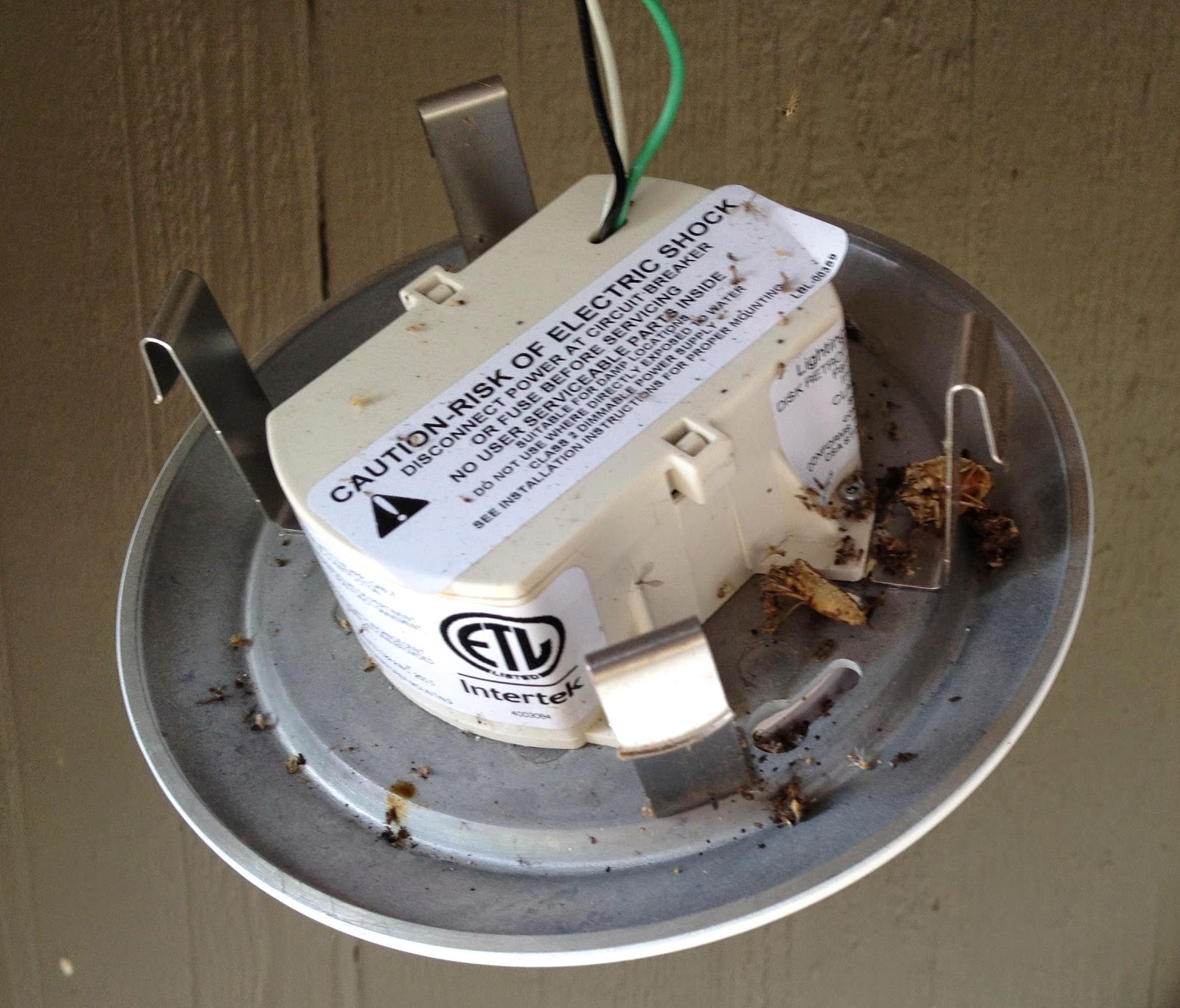
Quite a collection on the rim and lens!


Big bugs died too, seeking the light, including a pesky attic-dwelling stink bug and a cricket.


I am liable for what I have done, knowing better, and have promised to take back the 4" Glimpse, mostly at my loss, when a better product arrives. I continue to buy 4" Glimpse, with great restraint. I will not again install one outdoors. Where lights will last a lifetime, it is worse than absurd, to use them in a way that commands difficult annual maintenance. 


A message then to lighting manufacturers: don't leave paths to be explored by bugs. Most lights I will use do well in this. Lighting Science Group, please fix and upgrade diode boards in 4" Glimpse. Your four-year old product deserves to be killed by a little competition.

And now after dispensing more anger against manufacturers who don't constantly improve their products in a time of rapid evolution, I see I have overlooked my ticket out of trouble in this job. I needed only two strips of my Nashua Foilmastic tape over the two keyholes, to cover the light leaks. I will go back immediately, and fix all ten lights. I will stop thinking maybe there is an A19 LED light bulb that would have been a better retrofit. All cans, be damned!


Thirteen days on, I am taking down all ten exterior soffit 4” Glimpse lights, to cover slots that attract and admit bugs, applying strips of Nashua 367-17 foil-mastic tape. This is the fifth of five treated this morning, twenty five minutes into the task. Now-practiced, I will photograph the process. Thirteen days of bug accumulation is large, already visible as browning of the lens.


Lots of little bugs in just thirteen days!


The dusted and reassembled light is sealed with ~1” strips of Nashua 367-17 tape. Tape adhesion seems fine and durable on these new surfaces. Adhesion will be much less satisfactory on year-old surfaces, perhaps plasticized by bug traffic.


For Glimpse lights installed at first-floor level a year ago, I attached the green tethers. That attachment is now a nuisance. I will detach the tethers to take down lights, and will not reattach them. Note the can light hacking of soffits to 6 1/2” diameter. What a shame. In the future, penetrations will be minimal, in low voltage DC circuits. A house will last much longer than technology in its lighting.

Saturday, May 17, 2014

Nicor DLS, An Important New LED Plate Light

In simple and pretty packaging!


Here is a new and improved imitation of 6" Glimpse LED plate lights. Improved? Yes. This light behaves perfectly on a Cooper DAL06P dimmer. No hum. Dims to 10% or less, where Glimpse bottoms out at about 20%. Starts every time from a dimmed setting, where dimmed Glimpse typically fails to start about 20% of the time.

Imitation only, and a compliment of Glimpse design. Every mold and feature are new. So-close imitation, it is a test whether Glimpse had any patent protections.

I discovered this in a mailed catalog from e-conolite. Here is their catalog page:


I eagerly ordered one at that $39.99 price. I needed to know whether this might share weakness of the first-version 6" Glimpse, which also had a power conversion block mounting in the junction box. Here DC leads to the luminaire are strong and long stranded wire, safely separated by twist connectors, to have freedom in the junction box wiring. Glimpse had a fragile quick-connect at the luminare backside and other wiring which might tug apart irreparably.


Box contents: these parts and an instruction sheet. For a usual can light retrofit, just screw in the A19 plug, join the AC quick-connect, and pull up with springs. For fit on a 4" junction box it is much harder.


Under a trim ring, find two screws engaging the springs and a mounting bracket. Three screws will free the lens, allowing a peek inside.


The diode board is clean, with its labeling on the circuit side. The DC leads are securely strain-relieved.


There is no separate AC pigtail. One must snip off the A19 plug and competently strip the leads. The pigtail in this photo is from a large box full of Glimpse parts, that one may collect as an installer.


I will test the junction box installation, in a can light patch-out kit. The wired junction box feeds through the can light hole and is aligned with 1/2" drywall by two screws into 1 5/8" lengths of scrap 2x4.


What to do with the green lead with lug end? I want the lead to attach the luminaire to the ceiling while I connect DC wires. Here the green lead lug is at the point of a desired ground screw on the luminaire body. A 10-32 tapped hole in aluminum is easy, and worthwhile for a demonstration. I ask that the manufacturer add these screws in future production.


There is no consensus of what such green leads are for. They will almost always dangle in a can light retrofit. Sylvania 70732 has no such lead. Some might cut the lug off here and wire to power ground. Why? I see no more important use than as tethering convenience to protect the DC leads.


Here I have the luminaire tethered by the added ground screw, and by joined DC leads. Tension should be in the green lead. Manufacturer: don't make the green lead with lug end, too long.

Please imagine this as a condition where a home owner is painting ceilings. Electrical connections should be left alone, not threatened. The restraining wire will be greatly appreciated.


The DC lead retention grommet must align with this quadrant of the power block.


Luminaire mounting screws must align precisely with the bracket. Here a screw has failed to penetrate hard Densarmor drywall, bending the bracket out of alignment.


A practiced installer will pre-drill for mounting screws. If ceiling is plaster or tile, drilling of holes is mandatory.


As with Glimpse lights, the luminaire aligns tightly with the ceiling unless there is heavy uneven texture, coiled wires interfere, or the junction box protrudes from the ceiling. Note the diameter of a drywall plug to patch out a 7 1/4" can light hole, is within the luminaire rim. I try to make a perfect patch with texture match using flexible grout , but that may not matter.


Here is excessive  texture match perfection in a can light patch, a random art, upon a ring of bare Densarmor drywall. This is a usual achievement, done easily in two or three quick spatula passes over an hour. This RACO 175 box will be sealed air-tight all-around.


Here is a brightness comparison on my test stand, vs. 6" Glimpse.


Despite claimed lumens difference, I find these equal. Perfect color equivalence, too. I trust the Glimpse 750 lumens number. The Nicor DLS should then be rated 750 lumens too. For both, I call Brightness Number (750/450*B4) = B6.7. The equivalent incandescent bulb is 100 watts *750/450 = 167 watts, not the box-claimed 60 watts. What forces manufacturers to so-badly under-rate LED plate lights? This is very harmful. The box does not make energy savings claims, so further error is avoided.


At lowest setting of Cooper DAL06P dimmer, the Glimpse is perhaps 20% of full bright, and the Nicor DLS 10%. The Nicor DLS will be a much better night light.


At 6/10/2014, add direct evidence in side-by-side comparison, against the package label statement, "60 watt equivalent". I see that delivered illumination from the Nicor DLS is greater than that of a 60 watt incandescent, by nearly times-three.


Here, dim to the lowest setting of a Cooper DAL06P dimmer.The DLS is quite pretty at about 10% of full brightness. The incandescent on the same dimmer is far less bright and ugly, a very unsuitable night light.


Here are two beautiful Nicor DLS over a spa. The Nicor DLS replace 6" Glimpse that look exactly the same, but had annoying buzzing as wired with a dimmer. The Nicor DLS behave perfectly in a circuit with an ordinary dimmer. No hum. They dial down to no light without change of color. Why would anyone think "downlights" should be recessed? These are beautiful jewels, far more useful than a grain-of-sand similar investment in pearls.


Here is a nearly-completed kitchen remodel with five Nicor DLS LED lights set on RACO 175 junction boxes. I think this is much prettier than still-predominant placement of recessed lighting as silly incandescent bulbs hacked-up in cans.


Four new light positions were tried before cutting in the ceiling boxes, temporarily wiring as surface DC strings from a single AC to DC converter block in the microwave-duct cabinet.


This is progress toward our Residential LED Lighting future . But, Nicor thoughtlessly (I accuse) discontinued these lights in Spring, 2015. Distribution had been almost exclusively through e-conolite mail-order/ online sales. Gone there now without a trace . So sad. So mean. No thought to advise the path to our future. At Amazon , on 8/23/2015 I find one, used, at $40 with free shipping, and I find my full-of-praise review.


Nicor directs us to Nicor DLS56 and DLS4 lights that have different virtues. Please see my kind review of DLS4 . There I also mention DLS56, finding it just a better version, from the same factory in China, as the derailed seemingly-identical Sylvania 75094 at Lowe's stores. Derailed, I call it, because this is a defective replacement of much-praised Sylvania 70732 . Until Sylvania and Lowe's admit and fix their error, and maybe forever after, buy the Nicor DLS56, say at Thomson Electric .

 Readers of this post, for example in Tel Aviv this day and inspiring this expanded post, should help find means to bring back something like Nicor DLS 10/ 6" Glimpse, a 750 lumens light good for eight-foot ceilings. Please know that Nicor DLS56/ Sylvania 70732 Mod3 at 900 lumens, is too bright on an eight-foot ceiling. Check the math: 900 * (9/10, squared) is 730 lumens. At same pitch on a ceiling, the 900 lumens light is for nine-foot ceilings. Of what value then is the Nicor DLS4 replacement, at 671 lumens? Use it on eight-foot ceilings, but at closer pitch, quite a job in an existing finished room with present hard-wiring methods. Find DLS4 too bright in a closet or over a shower, where I prefer 450 lumens.


At 2/3/2018, read on about a next replacement of the wonderful DLS10 lights, with a driver-on-board product offered from China, called Nicor DSK56. A review is issued first as a Google Photos album .


At 10/2/2018, report disposition of the remaining six new-condition Nicor DLS10 in my inventory.


Here is kitchen appearance night-time with all lights on full. See sharp lines of iPhone camera focus. Our eyes, and our cameras, work ever better as light increases. The room is rather uniformly 400 Lux, and that is not harsh, too bright.
Dim when I want to. turn off all but the DINING circuit, dimmed as candlelight. Everything softens, where we wish to relax.


Saturday, April 12, 2014

Beyond 4" Glimpse

I'm looking for a 450 lumens dot, better than 4" Glimpse . A 450 lumens directional down light gives illumination below equivalent to a 100 watt point-source light bulb. I assign this illumination a Brightness Number B4, and think it will be the preferred unit of residential lighting. It is just right in my opinion, in eight-foot ceilings over hallways and other small spaces, as for a bath tub or shower.

I have proven the 4" Glimpse equivalence to a 100 watt incandescent in many unambiguous side-by-side comparisons, including this, my first:


100 watt incandescent at left. 4" Glimpse 3000°K, 450 lumens on right. The darker divider shadow would be behind the less-bright light. With slightly different color temperature, I call the two lights equal.


It is tragic when this Glimpse fully-revealed directional LED light is packaged as equal to a useless 45 watt bulb. Little wonder it is so poorly known, and not yet respected.


The 4" Glimpse diodes are tightly spaced on a simple board, slightly recessed within the lens frame. This four-year-old technology is now ancient, yet I know of no better light for its purpose. Know that it must be mounted on an air-tight box, else lens and mounting screw keys shine, attracting bugs. Despite defects, every lighting professional should experience this light. I recommend purchase at LED Lighting Wholesale . Look for then, and promote something better, in current technology.


Who will deliver a consumer luminaire with this better Samsung LED board of about 450 lumens?

http://www.samsung.com/global/business/led/lighting/led-engine/downlight-engine/detail/STIDMW830042112AAA 


3000°K
4.2 watts
480 lumens
114 lumens per watt
62 x 5.7 mm (2.4" diameter, 0.22" thickness)

The diodes are distributed better than Glimpse, and will be less glaring for same lumens.
I do find the source. Buy the boards here:
http://components.arrow.com/part/search/STIDMW830042112AAA%20?region=na

Who buys boards in this way, 180 minimum order? Please let it be someone who will package with least heat sink mass, a simple covering lens, push & pluck audio-jack connectors, and by-room DC wiring with in-wall conversion from house power. Can we move in this direction, away from stupid light bulbs, absent leadership for standards, as in a new L Prize?

This is my better L Prize vision:
I have proposed to US DOE that promoted LED lighting be as low-voltage DC-parallel strings of simple and small shining disks. We need a standard for a new common DC connector. This standard world-wide may be determined by competition as better expenditure in a next phase of the L Prize, than any new and stupid light bulb. All new light bulb installations stand in the way of adopting OLED when, soon, they are ready. The new L Prize for the connector sets a basis for the "starry skies" in our future. Luminares that clip into L Prize connectors might be called star lights. Such lighting will be dispersed and of small not-glaring size. Many of these little glow dots will be set in art pieces. They will be fun. They will be as nice or as simple as the user desires.

A proposal to US DOE? Never acknowledged. Some Booz Allen Hamilton contractor surely put it in the trash. Someone in Arlington answers if you call in follow-up. A real person, but without any options.


Here is an abbreviated savings comparison where luminaire density is that of an older home where 100 watt point source lighting was tolerated. New luminaires of brightness greater than B4 are down-rated in operating cost to that of B4 brightness, crediting dimming to B4, or value of the greater brightness to quality of life. Glimpse lights at 50 lumens per watt already wring out most of the potential savings. Further advances to >100 lumens per watt don't save much more in electricity cost, say another $15 over 35,000 hours, but do advance ability to live off-grid. Doesn't a more-efficient light run cooler? Advancing to >100 lumens per watt may be essential to small heat sink of a push/ pluck light.